
Search
Remove Ads
Advertisement
Search Results
Definition
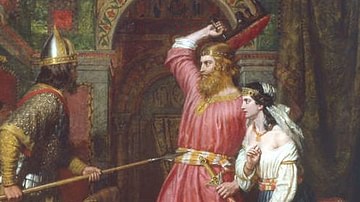
Alboin
Alboin (r. 560-572 CE) was a king of the Lombards who led his people into Italy and founded the Kingdom of the Lombards which lasted from 568-774 CE. His father was Audoin, King of the Lombards, and his mother Queen Rodelinda. He was...

Definition
Islam
Islam is an Abrahamic-monotheistic religion based upon the teachings of Prophet Muhammad ibn Abdullah (l. 570-632 CE, after whose name Muslims traditionally add “peace be upon him” or, in writing, PBUH). Alongside Christianity and Judaism...

Definition
Maria Theresa - The Great Habsburg Empress
Maria Theresa (1717-1780) was the ruler of the Habsburg Monarchy, a sprawling empire that included Austria, Hungary, Bohemia, and other territories spread out across Italy, the Netherlands, and Central Europe...

Definition
Spanish Main
The Spanish Main refers, in its widest sense, to the Spanish Empire in the Americas from Florida in the north to the northern coast of Brazil in the south, including the Caribbean. The term was initially more limited and referred...

Article
Vikings: Jewelry, Weapons & Social Change at The VIKINGR Exhibition
In April 2019, The Museum of Cultural History in Oslo, Norway, opened its doors to the new exhibition VÍKINGR, containing rich treasures and unique archaeological finds from the Viking...

Article
Byzantine-Armenian Relations
The relationship between the Byzantine Empire and ancient Armenia was a constant and varied one with an equal mix of wars, occupations, treaties of friendship, mutual military aid, and cultural exchange. Regarded as...

Definition
Leo III
Leo III was emperor of the Byzantine Empire from 717 to 741 CE. He founded the Isaurian dynasty which ruled until 802 CE. The emperor was a talented administrator, and he revamped the empire's political apparatus and legal code. Leo's...

Definition
Justinian I
Justinian I reigned as emperor of the Byzantine Empire from 527 to 565 CE. Born around 482 CE in Tauresium, a village in Illyria, his uncle Emperor Justin I was an imperial bodyguard who reached the throne on the death of Anastasius...

Definition
Byzantine Government
The government of the Byzantine Empire was headed and dominated by the emperor, but there were many other important officials who assisted in operating the finances, judiciary, military, and bureaucracy of a huge territory...

Definition
Byzantine Emperor
The Byzantine Emperor ruled as an absolute monarch in an institution which lasted from the 4th to 15th century CE. Aided by ministers, high-ranking nobility, and key church figures, the emperor (and sometimes empress) was commander-in-chief...
