
Search
Did you mean: Kappa?
Remove Ads
Advertisement
Search Results

Article
Elephants in Greek & Roman Warfare
In the search for ever more impressive and lethal weapons to shock the enemy and bring total victory the armies of ancient Greece, Carthage, and even sometimes Rome turned to the elephant. Huge, exotic, and frightening the life out of an...

Article
Treasures of Roman Tunisia - 10 Key Sites Explored
Set on the North African coast, Tunisia is home to some of the finest Roman ruins in the Mediterranean. After the fall of Carthage, Rome transformed the region into the prosperous province of Africa, enriched by its fertile plains and bustling...
Article
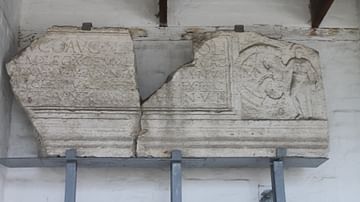
Legions of Syria
The Roman legions of Syria served as a buffer, protecting the Roman Empire not only externally from such threats as Parthia and the Sasanian Empire but also internally during the Great Jewish Revolt of 66 CE and the Bar-Kochba Revolt (132-135...

Video
Cult of Mithras Explained
The Cult of Mithras was a thriving religion in the Roman Empire. But by the 5th century....it was gone. What do we know about the Cult of Mithras? And what was its relationship with Christianity? Twitter: @andrewmarkhenry Blog: www.religionforbreakfast.com...

Image
Red-figured Hydria - Dance Training Session
Red-figured hydria (water-jar) displaying a dance-training (gymnopaida) session. Two young girls practice dancing under the supervision of a female and a male tutor. The girls wear short tunics (chiton) and take identical steps towards each...

Image
Political Map of Italy circa 1000 CE
Political map of Italy near the arrival of the Normans, who eventually conquered Southern Italy and Sicily, including the principalities of Salerno, Capua, and Benevento.

Image
Eos & the Slain Memnon
Eos lifting up the body of her son Memnon in the so-called "Memnon Pieta" on the interior of an Attic red-figure cup, signed by Douris (painter) and Kalliades (potter), from Capua, Italy, c. 490-480 BCE.
Louvre, Paris.
Image
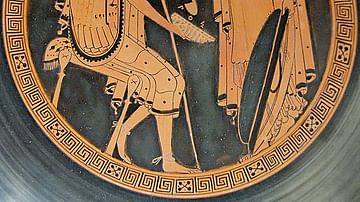
Chrysippus and Zeuxo
Zeuxo pours wine to Chrysippos on an Attic red-figured kylix by the Brygos painter, from the Brygos Tomb in Capua, c. 490-480 BCE.
The British Museum, London.

Image
Amphitheatre of El Djem
Ruins of a Roman amphitheatre in ancient Thysdrus, photograph by Carole Raddato, El Djem, Tunisia, 16 February, 2023. The Roman Amphitheatre of El Djem in Tunisia was constructed around 238 CE in the ancient city of Thysdrus, located in...
Image
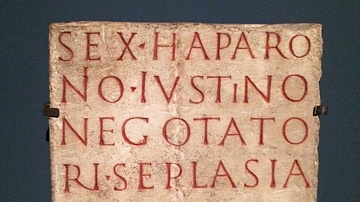
Inscription on the Tomb of an Perfume Trader
Sextus Haparonius Iustinus was a "seplasarius" — a trader in perfumes and unguents — who lived in what's present-day Cologne, Germany during the 2nd century CE. When he died, his "brothers" erected a funeral monument of stone in his honor...
