
Search
Did you mean: Kappa?
Remove Ads
Advertisement
Search Results

Image
Three Venus Statues
Three marble sculptures of “Venus” (left to right): Venus of Arles (194 cm, ca. late 1st cent. BCE; Louvre inv. no. Ma 439), proper right arm and lower left arm are modern restorations; Venus of Milos (202 cm, 100-50 BCE; Louvre inv. no...
Definition
Paestum
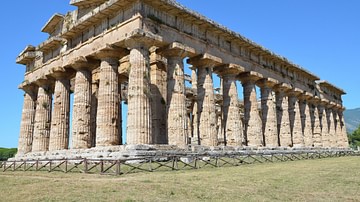
Paestum, also known by its original Greek name as Poseidonia, was a Greek colony founded on the west coast of Italy, some 80 km south of modern-day Naples. Prospering as a trade centre it was conquered first by the Lucanians and then, with...

Definition
Roman Verona
Verona, situated on the river Adige in northern Italy, was a Roman town probably founded some time in the 2nd century BCE. It was a colonia by 69 CE and the impressive monuments which survive to this day attest to the city's importance. In...

Definition
Saint Boniface
Saint Boniface (born as Wynfreth, l. 672-754) is one of the most famous saints in the Netherlands. He helped Pope Gregory II (r. 715-731), who was keen to convert pagan Germanic tribes, to achieve his goal, the Christianization of Europe...

Definition
Hasdrubal Barca
Hasdrubal Barca (c. 244-207 BCE) was the younger brother of the Carthaginian general Hannibal (247-183 BCE) and commanded the forces of Carthage against Rome in Spain during the Second Punic War (218-202 BCE). They were both, along with another...
Definition
Totila
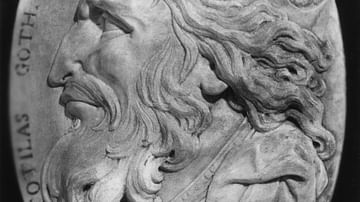
Totila (birth name, Baduila-Badua r. 541-552 CE) was the last great king of the Ostrogoths in Italy. He was the nephew of the Gothic king Ildibad who was succeeded by Eraric the Rugian (d. 541 CE). The Goths of Italy felt that Eraric was...
Image
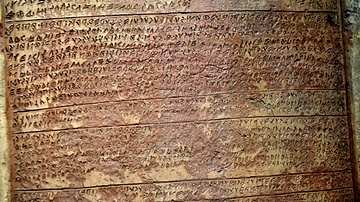
Etruscan Inscription
This is a detail of a large Etruscan ritual calander from Santa Maria Capua Vetere, Italy. The Etruscan language is preserved in about 10,000 short texts; the grave, votive, and ownership inscriptions. Only four longer texts are known so...

Article
Slavery in the Roman World
Slavery was an ever-present feature of the Roman world. Slaves served in households, agriculture, mines, the military, workshops, construction and many services. As many as 1 in 3 of the population in Italy or 1 in 5 across the empire were...
Article
Disarming Aphrodite: Rediscovering the Venus de Milo
The so-called Vénus de Milo is perhaps one of the most iconic works of Western art of any period. The statue of the goddess was found on the Aegean island of Milos, to which she owes her name, on the eve of the Greek War of Independence (1821-1830...

Article
Roman Games, Chariot Races & Spectacle
If there was one thing the Roman people loved it was spectacle and the opportunity of escapism offered by weird and wonderful public shows which assaulted the senses and ratcheted up the emotions. Roman rulers knew this well and so to increase...
