
Search
Remove Ads
Advertisement
Search Results

Article
The Impact of the British Industrial Revolution
The consequences of the British Industrial Revolution (1760-1840) were many, varied, and long-lasting. Working life in rural and urban settings was changed forever by the inventions of new machines, the spread of factories, and the decline...

Article
Social Change in the British Industrial Revolution
The British Industrial Revolution (1760-1840) witnessed a great number of technical innovations, such as steam-powered machines, which resulted in new working practices, which in turn brought many social changes. More women and children worked...

Article
Coal Mining in the British Industrial Revolution
Coal mining boomed during the British Industrial Revolution as it provided fuel for steam engines of all kinds in factories, transport, and agriculture. Draining flooded mines to extract more coal was the reason the steam engine was invented...

Article
Trade Unions in the British Industrial Revolution
Trade unions were formed in Britain during the Industrial Revolution (1760-1840) to protect workers from unnecessary risks using dangerous machines, unhealthy working conditions, and excessive hours of work. The trade union movement was vigorously...

Teaching Material
British East India Company - Interactive Lesson for High School
This interactive world history lesson takes a deep dive into the British East India Company and its expansion across the Indian subcontinent. Using interactive slides, students work through an interactive timeline, interpret maps, and complete...

Article
Battle of Isandlwana - The Zulu Victory over the British Empire
The Battle of Isandlwana on 22 January 1879 was the opening encounter of the Anglo-Zulu War and a famous Zulu victory against the British Army. Over 25,000 Zulu warriors attacked and destroyed a British-led force of 1,700 men camped at the...

Definition
Mauryan Empire
The Mauryan Empire (322 BCE - 185 BCE) supplanted the earlier Magadha Kingdom to assume power over large tracts of eastern and northern India. At its height, the empire stretched over parts of modern Iran and almost the entire Indian subcontinent...

Article
Child Labour in the British Industrial Revolution
Children were widely used as labour in factories, mines, and agriculture during the British Industrial Revolution (1760-1840). Very often working the same 12-hour shifts that adults did, children as young as five years old were paid a pittance...

Definition
Matabeleland (Kingdom) - The Ndebele Empire in Southern Africa
Matabeleland (1838-1897), also known as the Ndebele Empire or Mthwakazi by the Ndebele themselves, was an African state covering what is today part of southern Zimbabwe and northern South Africa. This area, which included other African peoples...
Definition
Empire
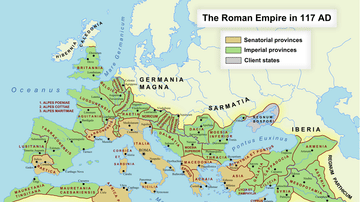
An empire is a political construct in which one state dominates over another state, or a series of states. At its heart, an empire is ruled by an emperor, even though many states in history without an emperor at their head are called "empires"...
