
Search
Remove Ads
Advertisement
Search Results
Image
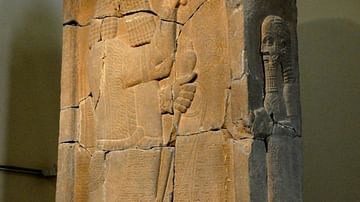
Sam'al Stele of King Esarhaddon
This commemorative basalt stele depicts the Assyrian king Esarhaddon worshiping gods and symbols of gods. The king's left hand holds a royal mace and two ropes. These ropes pass through the lips of two captives. The...
Image
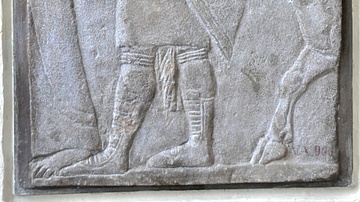
Capture of the Elamite city of Din-Sharri
This alabaster bas relief was part of a large wall relief that depicts the military campaign of Ashurbanipal against the Elamite city of Din-sharri. The relief shows an Assyrian soldier leading a captured woman...
Image
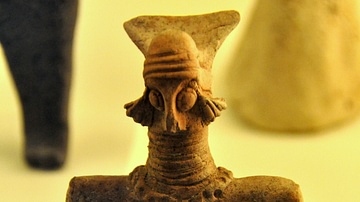
Votive Statuette from the Archaic Buildings of the Ishtar Temple
Only the upper half of this small female terracotta statuette has survived. The woman wears a hat and a necklace and covers her naked breasts with her hands. The Archaic buildings of the...

Image
A door socket from Anu-Adad Temple
The cuneiform inscriptions on this door socket mention the name of Shalmaneser III, King of Assyria (858-824 BCE). The king dedicated the stone to the gods Anu and Adad for his life and the well-being of his people...

Image
Aphrodite Killing the Giant
Detail from the Pergamon Altar's north frieze (The frieze depicts the Gigantomachy); Aphrodite killing the giant; built in 2nd century BCE; Today in the Pergamon Museum in Berlin.
Image
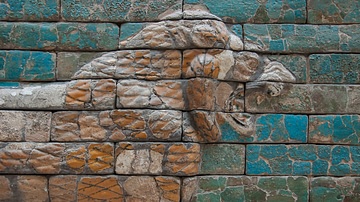
Lion from Ishtar Gate
Detail from the Ishtar Gate of Babylon, built in 6th century BCE by king Nebuchadnezzar II; part of the Gate is now reconstructed in Pergamon Museum in Berlin.

Image
Tribute Bearer from Nimrud
This alabaster bas-relief is part of a larger one depicting a sequence of tribute bearers. Here, this man shows a gesture of submission, reflected by his raised arms. The "Standard Inscription" of Ashurnasirpal II appears...

Image
Inscription of the Urartian King Sarduri II
The cuneiform inscription on this block mentions king Sarduri II, son of the king Argishti I. Sarduri II was a King of Urartu and was succeeded by his son, Rusa I. From Astwadzashen, 50 kilometers southeast...
Image
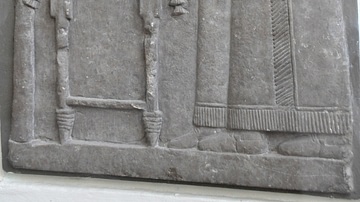
Assyrian Royal Horse Bridle
This gypsum wall panel depicts two female courtiers in front of a table, on which the royal horse bridle has been placed. Neo-Assyrian Period, reign of Ashurbanipal II, 660-650 BCE. From the North Palace at Nineveh, Mesopotamia...

Image
King Esarhaddon
A close-up view of the upper part of the so-called Victory Stele of Esarhaddon depicting the Assyrian king Esarhaddon praying in front of symbols of deities. From the citadel at Sam'al/Zincirli, modern Southern Turkey. Neo-Assyrian...
