
Search
Remove Ads
Advertisement
Search Results

Image
Model of an Egyptian Granary
Model of a granary. Wood. From Egypt, precise provenance is unknown. Middle Kingdom, 12th Dynasty, c. 1800 BCE. (The Neues Museum, Berlin, Germany).
Image
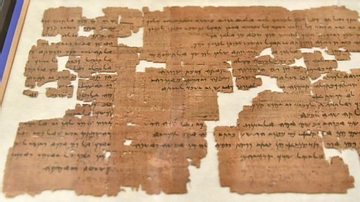
The Story of Ahiqar
This papyrus is written in Aramaic and mentions the story of Ahiqar (the Words of Ahikar) who was a chancellor to the Assyrian kings Sennacherib (r. 705-681 BCE) and Esarhaddon (r. 681-669 BCE). This papyrus came from Elephantine...
Image
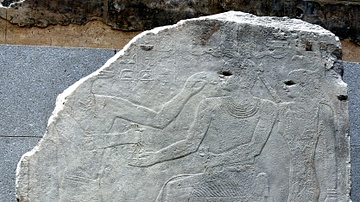
Relief of Niuserre Ini from Abusir
The Egyptian pharaoh Niuserre Ini (Nyuserre Ini, Neuserre Ini) sits on a throne and receives life from Anubis. Old Kingdom, 5th Dynasty, second half of the 25th century BCE. From the mortuary temple of Niuserre...

Image
Dahshur Decree of Pepi I
This is a detail of a large limestone fragment which came from the pyramid complex of the Egyptian pharaoh Sneferu (r. 2613 to 2589 BCE) of the 4th Dynasty of Egypt. This is one of the very few and important legal texts...
Image
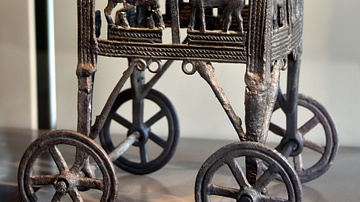
Cauldron Stand from Cyprus
This bronze wheeled stand once supported a cauldron. 12th to 11th century BCE. Probably from Kition in modern-day Larnaka, Cyprus. It is on display at the Neues Museum, Berlin, Germany.

Image
Block Statue of Nemti-hotep
Seated figure of the Egyptian steward Nemti-hotep. Quartzite. From Asyut, Egypt. Middle Kingdom, 12th Dynasty, reign of Senusret III, 1872-1853 BCE. It is on display at the Neues Museum, Berlin, Germany.

Image
Head of Antiochus IV
The youthful, clean-shaven face of the Seleucid king Antiochus IV Epiphanes (r. 175 - 164 BCE) resembles Alexander the Great (r. 356 - 323 BCE), with features of age, such as the high hairline rendering the image more realistic...
Image
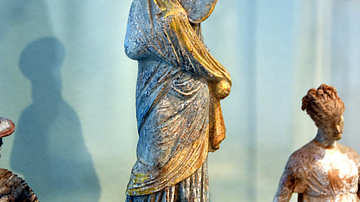
Tanagra Figurine
This small terracotta figurine is part of the so-called "Tanagra Figurines", which represent wealthy middle-class women. These statuettes served as votive and funerary objects, carrying a symbolic meaning connected with the status...
Image
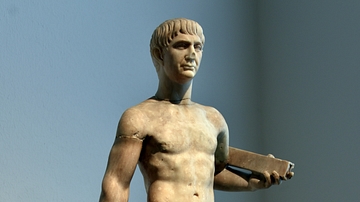
Statuette of Trajan
The head and torso of this statuette did not originally go together. The head is a portrait of the Roman Emperor Trajan (r. 98-117 CE). Records of the sculpture, first presumed to be a gladiator, can be traced back to the Venetian...
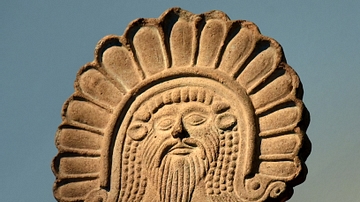
Image
Antefix Depicting Achelous
This leaf wreath antefix shows the head of Achelous. Achelous was the god of water and rivers of the whole world. Clay. From Curti, near Capua, Italy. Etruscan, 480-460 BCE. It is on display at the Altes Museum in Berlin...
