
Search
Remove Ads
Advertisement
Search Results

Image
Egyptian Cubit
Limestone fragment of an ancient Egyptian cubit in the shape of a five-edged ruler, from Egypt, precise provenance is unknown. New Kingdom of Egypt, 1550-1070 BCE.
The Neues Museum, Berlin.

Image
Sandals from Luxor
A pair of sandals with curves tip and footrest with footmarks. Plant fibers and wood. From Luxor, Egypt. 1550-870 BCE. (The Neues Museum, Berlin, Germany).
Image
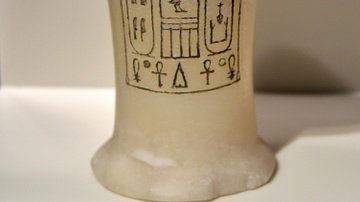
Jar of Pepi II
This calcite-alabaster jar (probably was a container for cosmetic oil) is inscribed with four royal titulary names of the Egyptian Pharaoh Pepi II (2284 - c. 2216 BCE). On the left is the nomen (birth name) of Pepi II. On the right...

Image
Sahure
This is a detail of a large limestone relief (showing the great royal hunting scene of the Egyptian pharaoh Sahure). Here, Sahure wears a knee-length kilt. From the Valley-Temple, Pyramid Complex of Sahure at Abusir, Egypt. Old Kingdom...
Image
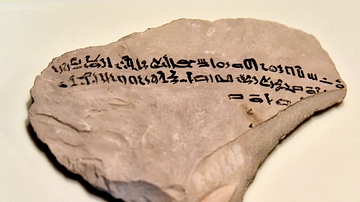
Ostracon about Quarrying
The hieratic script on this ostracon mentions the 43rd year of the reign of Thutmose III. A group of workers was sent to the quarry for the building materials of a temple, under the supervision of a man named Sen-Djehuti...

Image
Block Statue of Senenmut & Princess Neferure
Neferure was Hatshepsut's daughter. Senenmut was a confidant and educator of Neferure in addition to being an architect and government official. He was allowed to erect his own statues in Thebes (reflecting...

Image
Sculpture of Arsinoe II
The image of the Egyptian queen Arsinoe (reigned 278-270 BCE) and wife of Ptolemy II (c. 285-246 BCE) is similar to that of the goddess Aphrodite. The form of the mouth, with a protruding upper lip indented in the middle...

Image
Metope of Helios in Quadriga
This was part of a marble architrave. The row of sculpted metopes on the north side of the temple to the goddess of the city of Ilion, Athena, began with an image of the sun god's Quadriga rising out of the sea. Like...
Image
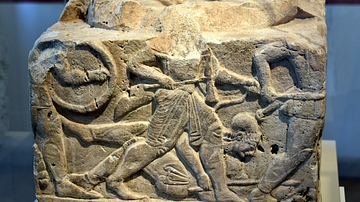
Base of a Cippus Showing Greeks & Amazons
The base is surrounded by a frieze of Greeks and Amazons, yet without fighting action. Possibly, this early Etruscan "Amazonomachy" is a game or a parade within the context of the death cult. The Amazons' clothing...
Image
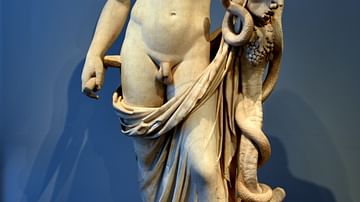
Colossal Statue of Antinous
The head and the statue are ancient but were combined as recently as the 18th century. The portrait depicts the Roman Emperor Hadrian's lover, Antinous, depicted with a snake and cornucopia. The attributes allow the statue...
