
Search
Remove Ads
Advertisement
Search Results

Image
Hunting Scene with Ostriches & Ibexes
Part of a hunting scene showing ostriches, ibexes, and a cub (upper register) and what appears to be a lizard and hunting dogs (lower register) in a hilly desert landscape. The upper part is the so-called Kheker...

Image
Edict from Medieval Egypt
This piece of papyrus is written using both Arabic and Greek languages about an edict of the governor of Egypt. The date is November 22, 713 CE. From Egypt, precise provenance is unknown. (The Neues Museum, Berlin, Germany...

Image
Wine Vessel in the Shape of Bes
Wine vessel in the shape of the Egyptian dwarf god Bes. The vessel is relatively well-preserved. Few such vessels of Bes with blue painting were found; this vessel is one of the best-surviving examples. Painted ceramic...
Image
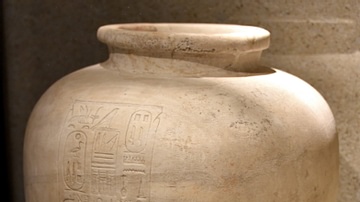
Jar of Pepi I
The hieroglyphic signs on this calcite-alabaster ovoid jar mention the name the Egyptian pharaoh Pepi I and his Sed festival, in addition to naming the pyramid complex of Pepi I (r. 2335-2285 BCE) at Memphis, the capital of the...
Image
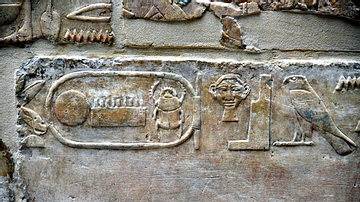
Prenomen of Thutmose III
This is a detail of a large limestone relief (showing a boat trip) that came from the Mortuary Temple of Hatshepsut at Deir el-Bahari, Egypt. The throne name (prenomen) cartouche of the Egyptian pharaoh Thutmose III (regined...
Image
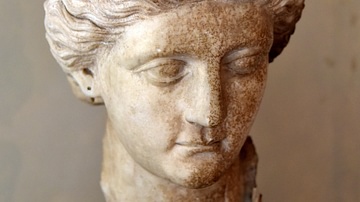
Head of a Roman Lady
This is the head of a Roman lady of the Julian-Claudian era. Marble. End of the 1st century to the mid-2nd century CE. From Troy, Turkey. It is on display at the Neues Museum, Berlin, Germany.

Image
Statue of Men-techenu
Seated figure of Men-techenu, the fanbearer of the pharaoh. Grano-diorite. From Thebes, Karnak, Egypt. New Kingdom, 18th Dynasty, reign of Thutmose III/Amenhotep II, 1479-1397 BCE. It is on display at the Neues Museum, Berlin...

Image
Statuette of Alexander the Great
This statuette once stood as a votive in the ritual chamber of the "Holy House" in Priene (Ionia Region, Turkey). The features of the statuette, as well as attributes like the flowing hair and emotional gaze, are...
Image
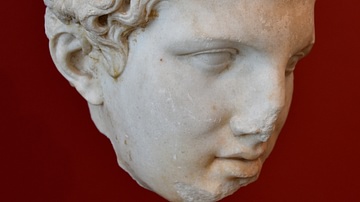
Portrait of a Hellenistic Ruler
This partly preserved head of a young man with idealized facial features is understood to represent a Hellenistic ruler, due to the band in his curly hair. Certain classification is however not possible. Historically...

Image
Head of a Sphinx from Vulci
This head belonged to a crouching sphinx with a lion's body and wings. It stood wither on a tumulus or as a "sentinel" at the entrance to the grave. Nenfro (tuff). From Vulci, Italy. Circa 600 BCE. It is on display at...
