
Search
Did you mean: Bes?
Remove Ads
Advertisement
Search Results

Article
Ten Ancient Mesopotamia Facts You Need to Know - Fun Facts on the Cradle of Civilization
Mesopotamia is the ancient Greek name (meaning "the land between two rivers," the Tigris and Euphrates) for the region corresponding to modern-day Iraq and parts of Iran...

Article
Death of Alexander the Great
In June of 323 BCE, Alexander the Great (r. 336-323 BCE) died in Babylon. His sudden death before his 33rd birthday has long been a point of speculation: was it disease, old wounds, or murder? Regardless of the cause...

Article
Parthian-Scythian Relations
While little is written about Parthian-Scythian relations, not only did the Parthians share origins with the Scythians and cooperated militarily but social, cultural, and commercial interactions were likely as well. Essentially...

Article
Mesopotamian City Laments - Suffering And The Will Of The Gods
The question "Why do bad things happen to good people?" has been asked for millennia, probably since before writing was invented, but at least since circa 1700 BCE when the Sumerian (and later...

Article
Ancient Mesopotamian Beliefs in the Afterlife
Unlike the rich corpus of ancient Egyptian funerary texts, no such “guidebooks” from Mesopotamia detail the afterlife and the soul's fate after death. Instead, ancient Mesopotamian views of the afterlife...

Article
The Ancient Celtic Pantheon
The ancient Celtic pantheon consisted of over 400 gods and goddesses who represented everything from rivers to warfare. With perhaps the exception of Lugh, the Celtic gods were not universally worshipped across Iron Age...

Article
Ten Great Ancient Mesopotamian Women - Monarchs, Generals, and Scribes
The lives of women in ancient Mesopotamia were regulated by a patriarchal hierarchy, but within this social structure, there were many who distinguished themselves and some who were able...

Article
The Curse of Agade - Naram-Sin's Fictional Battle with the Gods
The Curse of Agade (also given as The Cursing of Agade) is a poem dated to the Ur III period of Mesopotamia (circa 2112 to circa 2004 BCE), though it is thought to be somewhat older in origin...

Article
History of Assyria
The foundation of the Assyrian dynasty can be traced to Zulilu, who is said to have lived after Bel-kap-kapu (c. 1900 BCE), the ancestor of Shalmaneser I. The city-state of Ashur rose to prominence in northern Mesopotamia, founding...
Image
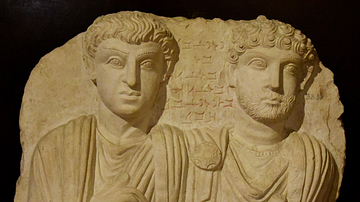
Funerary Relief from Palmyra of a Man and his Son
The inscription on this funerary relief says that the two figures are "Yedi Bel" and his son "Zabde'atach". Limestone. Roman Period, 200-273 CE. From Palmyra, in modern-day Syria. (Museum of Archaeology...
