
Search
Remove Ads
Advertisement
Search Results

Definition
Kikimora
Kikimora (pronounced Kih-kee-mora) is a female house spirit from Slavic lore who can be helpful or malevolent depending on the behavior of the homeowner. In differing versions of her stories, there are two kinds of spirit, one generally...

Definition
Hippolyta
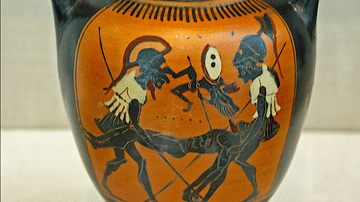
Hippolyta, or Hippolyte, was a queen of the Amazons in Greek mythology. A daughter of Ares, the Greek god of war, and Otrera, queen of the Amazons, she is a significant figure in the legends of Hercules and Theseus. In the present...
Definition
Thanatos
Thanatos is the personification of Death in Greek mythology. He is the son of Nyx (Night) and the twin brother of Hypnos (Sleep). Some sources also name Erebus (Darkness) as his father. As the personification of Death, Thanatos works...

Definition
William III of England
William III of England (also William II of Scotland, r. 1689-1702) became king of England, Scotland, and Ireland after the Glorious Revolution of 1688. Protestant William, Prince of Orange, was invited to rule jointly with...

Definition
Indian Princely States
The Indian Princely states (aka Native States or Princely India) were those states in the Indian subcontinent the British did not conquer but which were typically bound by treaty first to the East India Company and then to...

Definition
Native Peoples of North America
The Native Peoples of North America (also known as American Indians, Native Americans, Indigenous Americans, and First Americans) are the original inhabitants of North America believed to have migrated into the region...

Definition
Townshend Acts
The Townshend Acts were a series of acts passed by the Parliament of Great Britain between 1767 and 1768 to tax and regulate the Thirteen Colonies of North America. When the colonists considered the acts an abuse of power and protested...

Definition
Homer
Homer (c. 750 BCE) is perhaps the greatest of all epic poets and his legendary status was well established by the time of Classical Athens. He composed (not wrote, since the poems were created and transmitted orally, they were not written...

Definition
Xerxes I
Xerxes I (l. 519-465, r. 486-465 BCE), also known as Xerxes the Great, was the king of the Persian Achaemenid Empire. His official title was Shahanshah which, though usually translated as `emperor', actually means `king of kings'. He...

Definition
Roman Gladiator
A Roman gladiator was an ancient professional fighter who usually specialised with particular weapons and types of armour. They fought before the public in hugely popular organised games held in large purpose-built arenas throughout...
