
Search
Did you mean: Basil II?
Remove Ads
Advertisement
Search Results

Image
Episcopal Complex at Novae
Episcopal Complex at Novae, photograph by Carole Raddato, Bulgaria, 13 August, 2024. The Episcopal Complex at Novae, Bulgaria. Developed from the early 5th century CE, the complex included a large three-aisled basilica...
Image
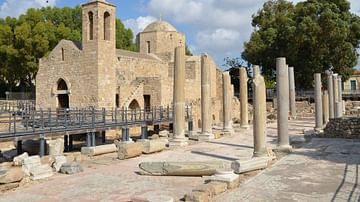
Panagia Chrysopolitissa Church, Cyprus
The Byzantine basilica of Panagia Chrysopolitissa was built at the end of the 4th century CE and destroyed in the middle of the 7th century CE. It the largest basilica ever excavated in Cyprus.

Image
Forum of Nicopolis ad Istrum
Forum of Nicopolis ad Istrum, photograph by Carole Raddato, 12 August, 2024. The forum of Nicopolis ad Istrum, Bulgaria. The paved square was surrounded by an Ionic colonnade and contained pedestals for marble and bronze...

Image
Roman Forum of Dion, Greece
The Roman Forum of Dion in Macedonia (Greece) was built over the top of the Hellenistic agora in the late 2nd century CE. The new forum consisted of a rectangular paved courtyard measuring 58 x 68 metres (190 x 223 ft...

Image
Mausoleum of Galla Placidia in Ravenna
Mausoleum of Galla Placidia (388-450 CE), near San Vitale’s Basilica in Ravenna. The inside shows stunning mosaics, but it never saw the body it was built for (c. 425-450), because Galla Placidia was buried...

Image
Principia of Novae
Principia of Novae, photograph by Carole Raddato, Bulgaria, 13 August, 2024. The principia (legionary headquarters) of Novae, Bulgaria. Situated at the centre of the fortress, the complex contained a monumental entrance, colonnaded...

Image
Phrygian Captive, Corinth
Colossal statue of a Phrygian Captive used as a pier in the 'Captives Facade' of the north Basilica, Corinth (second half 2nd century to early 3rd century CE), Corinth Archaeological Museum.
Image
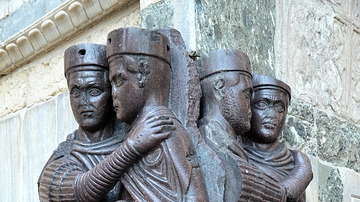
Portrait of the Four Tetrarchs
Porphyry sculpture portraying the four Tetrarchs (Diocletian, Maximianus, Galerius and Constantius Chlorus) embracing. It is dated to c. 300 CE and was sculpted in Asia Minor. It probably originally decorated two separate...

Image
Curia at Augusta Raurica
The Roman curia was the town hall of Augusta Raurica. This was where the town council consisting of 100 councillors or "decuriones" held its meetings with the "duoviri," the two mayors. The town councillors were held in...

Image
Obelisk at Piazza della Minerva
The obelisk standing in the Piazza della Minerva is the smallest of Rome’s obelisks and it is positioned on the back of an elephant sculpted by Gian Lorenzo Bernini (1598 – 1680 CE). The origins of this obelisk are...
