
Search
Remove Ads
Advertisement
Search Results

Definition
Clovis I
Clovis I (or Chlodovech, 466-511/513 CE), king of the Franks, is considered the founding father of the Merovingian Dynasty, which would continue for over 200 years. Clovis became king at the age of 15, and by the time of his death 30...

Definition
Homo Erectus
Homo erectus, or 'upright man', is an extinct species of human that occupies an intriguing spot within the human evolutionary lineage. These prehistoric hunter-gatherers were highly successful in adapting to vastly different habitats...

Definition
Punic Wars
The Punic Wars were a series of conflicts fought between Carthage and Rome between 264 BCE and 146 BCE. The name Punic comes from the word Phoenician (Phoinix in the Greek, Poenus from Punicus in Latin) as applied to the citizens...

Definition
Nergal - The Mesopotamian God of Death, War, and Destruction
Nergal (also known as Erra and Irra) is the Mesopotamian god of death, war, and destruction. He began as a regional, probably agricultural, god of the Babylonian city of Kutha in the Sumerian...
Definition
Punt
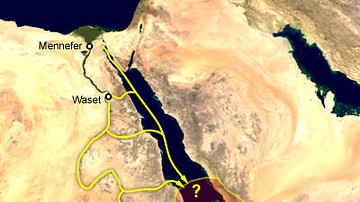
The Land of Punt was a region in Africa (most likely Somalia) referenced by inscriptions of ancient Egypt initially as a partner in trade and, later, as a semimythical country rich in resources and exotic goods. It is best known from the...
Definition
Orion - The Hunter Who Became a Constellation
Orion was the great hunter of Greek mythology who was famed for his good looks and many love affairs. Either his assault of or admiration from Artemis resulted in the gods transforming the giant into a constellation...

Definition
Nile
The world's longest river, located in Egypt, the Nile flows 4,132 miles (6,650 kilometres) northward to the Mediterranean Sea (a very unusual direction for a river to take). It was considered the source of life by the ancient Egyptians...
Definition
Vulci
Vulci (Velch) was an Etruscan city located 12 km from the western coast of central Italy by the banks of the Fiora River. Flourishing as a trading port between the 6th and 4th century BCE, it was an important member of the Etruscan League...

Definition
Diotid Dynasty
The Diodotids were a Greco-Bactrian dynasty of kings, composed of the two rulers Diodotos I and his son Diodotos II. The dynasty lasted between c. 250 BCE and c. 230 BCE, which was very short but significant because Diodotos I...

Definition
Etruscan Language
The language of the Etruscans, like the people themselves, has remained somewhat mysterious and has yet to be fully understood. The alphabet used a western Greek script, but the language has presented difficulties to scholars...
