
Search
Remove Ads
Advertisement
Search Results

Definition
Pazuzu - The Mesopotamian Demon of Destruction and Protection
Pazuzu is a Babylonian/Assyrian demon who was most popular in the first millennium BCE. He was the son of Hanbi (also Hanba), king of the demons of the underworld, and brother of Humbaba, the...

Article
Fatima Al-Fihri and Al-Qarawiyyin University
Fatima Al-Fihri (c. 800-880) was a Muslim woman, scholar and philanthropist who is credited with founding the world’s oldest, continuously running university during the 9th century: the University of Al-Qarawiyyin...

Definition
Gilgamesh
Gilgamesh is the semi-mythic King of Uruk best known as the hero of The Epic of Gilgamesh (c. 2150-1400 BCE) the great Babylonian poem that predates Homer's Iliad and Odyssey by 1500 years and, therefore, stands as the oldest piece...

Definition
Thomas Hobbes
Thomas Hobbes (1588-1679) was an English philosopher who famously summarised his pessimistic view of human nature in his greatest work, Leviathan, published in 1651. Hobbes believed that the life of humanity in the state of nature...

Definition
Marduk - The Great God of Babylon
Marduk was the patron god of Babylon who presided over justice, compassion, healing, regeneration, magic, and fairness, although he is also sometimes referenced as a storm god and agricultural deity. He rose to prominence...

Definition
Library of Ashurbanipal
The Library of Ashurbanipal (7th century BCE) is the oldest known systematically organized library in the world, established in Nineveh by the Neo-Assyrian king Ashurbanipal (r. 668-627 BCE) to preserve the history and culture...

Definition
Hypatia of Alexandria
Hypatia of Alexandria (c. 370 - March 415) was a female philosopher and mathematician, born in Alexandria, Egypt possibly in 370 (although some scholars cite her birth as c. 350). Little is known of her life but her dramatic...
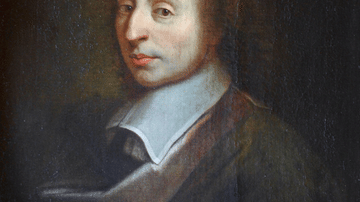
Definition
Blaise Pascal
Blaise Pascal (1623-1662) was a French scientist, mathematician, and philosopher whose work influenced both the Scientific Revolution and later European thought. Pascal is known for his practical achievements in science, such as...

Article
Visiting the Ancient City of Babylon
We had a 4-day national holiday. Meaning what? No clinic and no hospital! I said to myself, “It's been a long time since I have visited Babylonia.” I drove my car for about 11 hours, continuously. Finally, I was...

Definition
Archimedes
Archimedes (l. 287-212 BCE) was a Greek engineer and inventor who is regarded as the greatest mathematician of antiquity and one the greatest of all time. He is credited with a number of inventions still in use today (such as the...
