
Search
Remove Ads
Advertisement
Search Results

Image
Babylonian Statue of Enki
A statue of Ea, the Akkadian god of water (related to the Sumerian god Enki). Ea is enthroned and holds a cup in his left hand, the right hand has been lost to time. He is accompanied by two creatures (half human and half...

Image
Stela from Babylonian Marduk Temple
This stela came from the Temple of Marduk in Babylon. It is a commemorative monument set up in honour of a private individual called Adad-Etir. He was an official in the temple, known as 'the dagger bearer', and...

Image
Babylonian Cuneiform Lexical List
Late Babylonian lexical list of personal names on a clay tablet.
Image
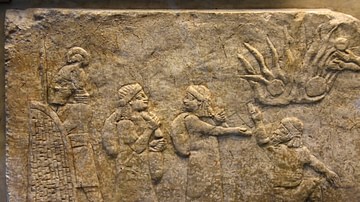
Assyrian Relief Showing Babylonian Prisoners
Assyrian alabaster panel showing Babylonian prisoners in a camp, from the North Palace at Nineveh, Northern Mesopotamia, modern-day Iraq, Neo-Assyrian Empire, reign of Ashurbanipal II, 668-630 BCE. To the...
Definition
Roman Science
The Romans assimilated earlier Greek science for their own purposes, evaluating and then accepting or rejecting that which was most useful, much as they did in other fields such as warfare, art, and theatre. This assimilation of...

Definition
Nebuchadnezzar II
Nebuchadnezzar II (r. 605/604-562 BCE) was the greatest King of ancient Babylon during the period of the Neo-Babylonian Empire (626-539 BCE), succeeding its founder, his father, Nabopolassar (r. 626-605 BCE). He is best known...

Definition
Hipparchus of Nicea - Greatest Astronomer of His Time
Hipparchus of Nicea (l. c. 190 - c. 120 BCE) was a Greek astronomer, geographer, and mathematician regarded as the greatest astronomer of antiquity and one of the greatest of all time. He is best known...

Definition
Thales of Miletus
Thales of Miletus (l. c. 585 BCE) is regarded as the first Western philosopher and mathematician. He was born and lived in Miletus, a Greek colony in Ionia (modern Turkey) referenced as the birthplace of Greek Philosophy because...
Image
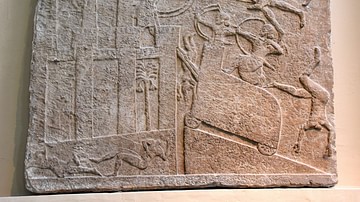
Babylonian City under Assyrian Siege
Assyrian relief showing a siege, from the Central Palace at Nimrud (ancient Kalhu), Mesopotamia, Iraq. Date palms indicate that the city, most of which was on an adjacent slab, was probably Babylonia. The Assyrians...
Image
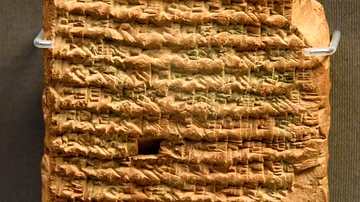
Babylonian Tablet Mentioning Coin Payments
This tablet records the exact coins required for transaction in Babylon. Because coins could circulate for many years, freshly minted coins were less worn and had a better silver weight. The tablet specifies...
