
Search
Remove Ads
Advertisement
Search Results

Definition
Ardashir I
Ardashir I (l. c. 180-241 CE, r. 224-240 CE) was the founder of the Persian Sassanian Empire (224-651 CE) and father of the great Sassanian king Shapur I (r. 240-270 CE). He is also known as Ardashir I Babakan, Ardeshir I, Ardashir...
Definition
Orisha
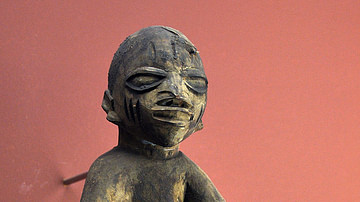
Orisha (also given as Orisa and Orishas) are supernatural entities usually referred to as deities in the Yoruba religion of West Africa, though they are actually emanations or avatars of the supreme being Olodumare. Their number is usually...

Definition
Thales of Miletus
Thales of Miletus (l. c. 585 BCE) is regarded as the first Western philosopher and mathematician. He was born and lived in Miletus, a Greek colony in Ionia (modern Turkey) referenced as the birthplace of Greek Philosophy because...

Definition
John Calvin
John Calvin (l. 1509-1564) was a French Reformer, pastor, and theologian considered among the greatest of the Protestant Reformation along with Martin Luther (l. 1483-1546) and Huldrych Zwingli (l. 1484-1531). Calvin synthesized the...

Definition
Islam
Islam is an Abrahamic-monotheistic religion based upon the teachings of Prophet Muhammad ibn Abdullah (l. 570-632 CE, after whose name Muslims traditionally add “peace be upon him” or, in writing, PBUH). Alongside Christianity and Judaism...

Definition
Hinduism
Hinduism is the oldest religion in the world, originating in Central Asia and the Indus Valley, still practiced in the present day. The term Hinduism is what is known as an exonym (a name given by others to a people, place, or concept...

Definition
Fertile Crescent - A Modern Term For An Ancient Region
The Fertile Crescent, often called the 'cradle of civilization', is the region in the Middle East that curves like a quarter-moon shape from the Persian Gulf through modern-day southern Iraq, Syria...

Interview
Rubin Museum's Faith and Empire: Tibetan Buddhist Art
Faith and Empire: Art and Politics in Tibetan Buddhism, a new exhibition at the Rubin Museum of Art in New York, explores the dynamic historical intersection of politics, religion, and art as reflected...

Definition
Marcus Aurelius
Marcus Aurelius (r. 161 to 180 CE) was a Roman emperor best known as the last of the Five Good Emperors of Rome (following Nerva, Trajan, Hadrian, and Antoninus Pius) and as the author of the philosophical work Meditations. Although...

Definition
The Saxons
The Saxons were a Germanic people of the region north of the Elbe River stretching from Holstein (in modern-day Germany) to the North Sea. The Saxons who migrated to Britain in the 5th and 6th centuries CE along with the Angles, Frisians...
