
Search
Remove Ads
Advertisement
Search Results

Definition
Code of Hammurabi - The Most Influential Law Code of the Ancient World
The Code of Hammurabi was a set of 282 laws inscribed in stone by the Babylonian king Hammurabi (reign 1792-1750 BCE), who conquered and then ruled ancient Mesopotamia. Although his law...

Definition
Borobudur
The Temple of Borobudur or sometimes "Barabudur" is a Mahayana Buddhist temple located close to Muntilan on the island of Java in Indonesia. Built during the rule of the Sailendra Dynasty (c. 650-1025 CE), Borobudur remains the world's...

Definition
Set (Egyptian God)
Set, also known as Seth and Suetekh, was the Egyptian god of war, chaos, and storms, brother of Osiris, Isis, and Horus the Elder, uncle to Horus the Younger, and brother-husband to Nephthys. His other consort was the goddess...

Definition
War of the Spanish Succession - The Bloody Struggle for the Throne of Spain
The War of the Spanish Succession (1701-1714) was the first of several major wars fought between the great powers of Europe in the 18th century. Triggered by the death of the sickly...

Definition
Sardis
Sardis (near modern-day Sart, Turkey) was the capital of the ancient Kingdom of Lydia founded (according to Herodotus) by the Heracleidae, the Heraclid Dynasty descended from the hero Heracles (Hercules). The city was famous in antiquity...

Definition
Ancient Egypt - The Land of the Gods of Balance and Harmony
Egypt is a country in North Africa, on the Mediterranean Sea, and is home to one of the oldest civilizations on Earth. The name "Egypt" comes from the Greek Aegyptos, which was the Greek pronunciation...

Image
Tang Dynasty Provinces c. 742 CE
The provinces of the Tang Dynasty c. 742 CE. The Tang Dynasty (618-907 CE) is regularly cited as the greatest imperial dynasty in ancient Chinese history. It was a golden age of reform and cultural advancement, which...

Interview
Rubin Museum's Faith and Empire: Tibetan Buddhist Art
Faith and Empire: Art and Politics in Tibetan Buddhism, a new exhibition at the Rubin Museum of Art in New York, explores the dynamic historical intersection of politics, religion, and art as reflected...

Definition
Seleucid Empire
The Seleucid Empire (312-63 BCE) was the vast political entity established by Seleucus I Nicator ("Victor" or "Unconquered", l. c. 358-281 BCE, r. 305-281 BCE), one of the generals of Alexander the Great who claimed a part of...
Definition
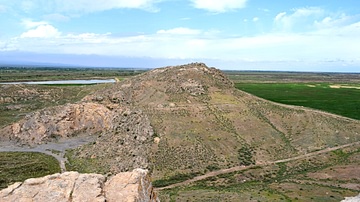
Artashat
Artashat (aka Artaxata) was the capital of Ancient Armenia from 176 BCE and remained so for over 300 years of the kingdom's history. Located just south of Armenia's modern capital Yerevan, according to the ancient historian Plutarch...
