
Search
Remove Ads
Advertisement

 This answer was generated by
 Search Results

Definition
Seventh Crusade
The Seventh Crusade (1248-1254 CE) was led by the French king Louis IX (r. 1226-1270 CE) who intended to conquer Egypt and take over Jerusalem, both then controlled by the Muslim Ayyubid Dynasty. Despite the initial success of...

Definition
Tang Dynasty
The Tang Dynasty (618-907 CE) was one of the greatest in Imperial Chinese history. It was a golden age of reform and cultural advancement which lay the foundation for policies which are still observed in China today. The second emperor...

Definition
Han Dynasty
The Han Dynasty (202 BCE - 220 CE) was the second dynasty of Imperial China (the era of centralized, dynastic government, 221 BCE - 1912 CE) which established the paradigm for all succeeding dynasties up through 1912 CE. It succeeded...
Image
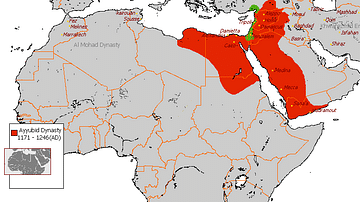
Map of the Ayyubid Empire
A map indicating (in red) the greatest extent of the Ayyubid Dynasty's empire (1171-1250 CE). Green indicates the areas controlled by the Crusader states (aka Latin East).

Definition
Shang Dynasty
The Shang Dynasty (c. 1600-1046 BCE) was the second dynasty of China, which succeeded the Xia Dynasty (c. 2070-1600 BCE) after the overthrow of the Xia tyrant Jie by the Shang leader, Tang. Since many historians question whether...

Definition
Qin Dynasty
The Qin Dynasty (221-206 BCE) was the first dynasty of Imperial China (defined as the era of centralized, dynastic government in China between 221 BCE and 1912 CE) which united the separate states following the Warring States Period...

Definition
Ming Dynasty
The imperial Ming dynasty ruled China from 1368 to 1644. It replaced the Mongol Yuan dynasty which had been in power since the 13th century. Despite challenges from abroad and within, the Ming dynasty oversaw an unprecedented growth...

Definition
Xia Dynasty
The Xia Dynasty (c. 2070-1600 BCE) was the first government to emerge in ancient China and the first to adopt the policy of dynastic succession. Consequently, the Xia was the first dynasty of China. Long regarded as a mythical construct...

Definition
Zhou Dynasty
The Zhou Dynasty (1046-256 BCE) was among the most culturally significant of the early Chinese dynasties and the longest lasting of any in China's history, divided into two periods: Western Zhou (1046-771 BCE) and Eastern Zhou (771-256...
Image
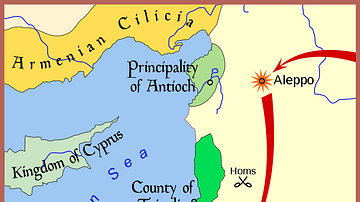
Conquest of Ayyubid Syria by Mongols
A map showing Mongol movements and targets in the year 1260 CE in the Levant (Palestine and Syria).
