
Search
Remove Ads
Advertisement
Search Results
Image
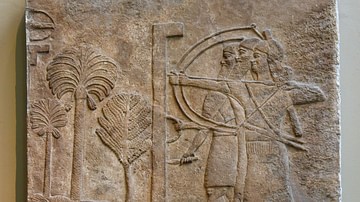
Babylonia under Assyrian Siege
Assyrian relief, from the Central Palace at Nimrud (ancient Kalhu), Mesopotamia, Iraq, from the reign of Tiglath-Pileser III, c. 728 BCE. Date palms indicate that the city, most of which were on an adjacent slab, was probably Babylonia...
Image
Assyrian Soldiers Slaughtering their Enemies
Alabaster bas-relief showing defeated soldiers being seized and killed by Assyrian soldiers. Neo-Assyrian Period, 865-860 BCE. Detail of Panel 9 (top), Room B, the North-Palace Palace, Nimrud, modern-day Iraq. (Th British Musuem, London)
Image
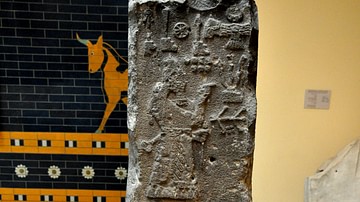
Stela of the Assyrian King Adad Nirari III
Stela of Adad Nirari III, erected by one of the king's local governors, Nergal-Eres, found in Saba, Neo-Assyrian Empire, 810-783 BCE. The stela features the Assyrian King Adad Nirari III praying in front of god symbols, and the inscriptions...
Image
Assyrian Soldiers with Iron Crowbars
Alabaster bas-relief depicting Assyrian soldiers using iron crowbars. Neo-Assyrian Period, 865-860 BCE. Detail of Panel 4 (bottom), Room B, the North-Palace Palace, Nimrud, modern-day Iraq. (The British Museum, London)
Image
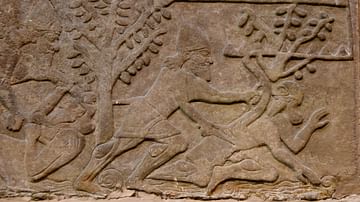
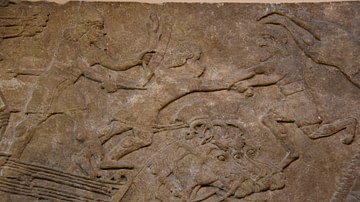
Assyrian Enemies Trying to Escape
Alabaster bas-relief showing two defeated soldiers trying to escape form the Assyrian army. Neo-Assyrian Period, 865-860 BCE. Detail of Panel 9 (top), Room B, the North-Palace Palace, Nimrud, modern-day Iraq. (The British Museum, London)
Image
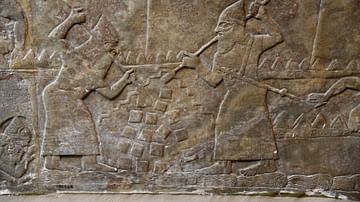
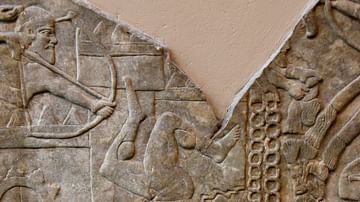
Assyrian Soldiers Attacking a City
Alabaster bas-relief depicting an overwhelming Assyrian attack on a city. Neo-Assyrian Period, 865-860 BCE. Detail of Panel 5 (bottom), Room B, the North-Palace Palace, Nimrud, modern-day Iraq. (The British Museum, London)
Image
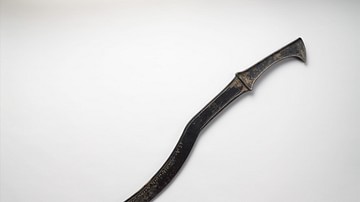
Assyrian Sickle Sword
A bronze Assyrian sickle sword that is believed to have belonged to the Assyrian king Adad Nirari I (r. 1307-1275 BCE), made in northern Mesopotamia, c. 13th century BCE. The blade bears the cuneiform inscription: "Palace of Adad-nirari...
Image
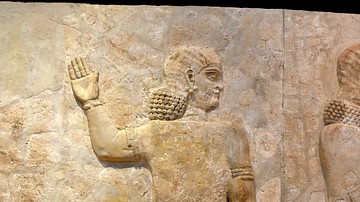
Assyrian Master of Ceremonies
Alabaster-bas relief, part of a long tributary scene, where the Assyrian king, Sargon II (not shown here), stands majestically, waiting to receive the tribute from Urartu (modern-day Armenia). From the Royal Palace of Sargon II at Khorsabad...
Image
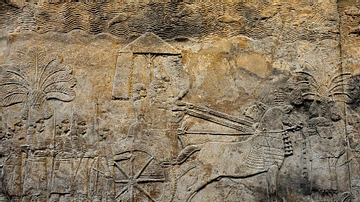
Assyrian Military Campaign in Southern Mesopotamia
The Assyrian king in a chariot watches as prisoners are brought in and heads and booty are piled-up in a palm grove. Neo-Assyrian era, 640-620 BCE, Mesopotamia, Iraq. From Nineveh, south-west palace, court XIX, panels 10-12. (The British...
Image
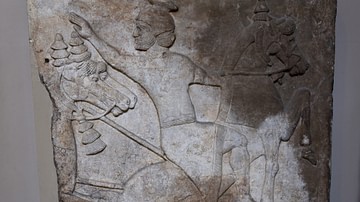
Surrender of Horseman, Assyrian Relief
Assyrian relief, from the Central Palace at Nimrud (ancient Kalhu), Mesopotamia, modern-day Iraq, reused later in the South-West Palace, from the reign of Tiglath-Pileser III, c. 728 BCE. This scene, with a fleeing enemy horseman turning...
