
Search
Remove Ads
Advertisement
Search Results

Article
History of Assyria
The foundation of the Assyrian dynasty can be traced to Zulilu, who is said to have lived after Bel-kap-kapu (c. 1900 BCE), the ancestor of Shalmaneser I. The city-state of Ashur rose to prominence in northern Mesopotamia, founding trade...
Definition
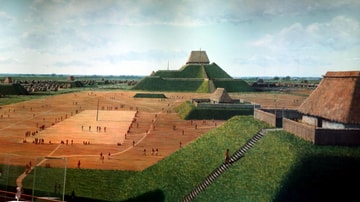
Pre-Colonial North America
Pre-Colonial North America (also known as Pre-Columbian, Prehistoric, and Precontact) is the period between the migration of the Paleo-Indians to the region between 40,000-14,000 years ago and contact between indigenous tribes and European...
Image
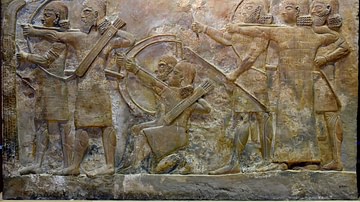
Assyrian Archers from Khorsabad
Assyrian relief depicting a group of Assyrian archers attacking an enemy (not shown here), from the Royal Palace of Sargon II at Khorsabad, in modern-day Nineveh Governorate, Iraq, c. 710 BCE. A soldier holding a large and long shield stands...

Image
Assyrian Soldiers Holding Decapitated Heads of Nubian Soldiers
Detail of a large gypsum wall panel, depicting the Assyrian attack on a fortress at the Egyptian city of Memphis in 667 BCE, Panel 17, Room M of the North Palace at Nineveh, Northern Mesopotamia, modern-day Iraq, Neo-Assyrian Empire, 645-635...

Image
Assyrian Army Assault on Lachish
Assyrian relief, from the South-West palace at Nineveh (modern Kuyunjik, Mousil city, Iraq), room XXXVI, panel 7, Neo-Assyrian Empire, 700-692 BCE. This wall relief delivers a very vivid description of the battlefield. The Assyrian army...
Image
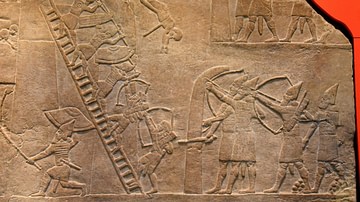
Assyrian Archers Attacking an Egyptian Fortress at Memphis
Detail of a large gypsum wall panel showing the Assyrian army attacking the Egyptian city of Memphis and commemorating the final victory of the Assyrian king Ashurbanipal II over the Egyptian king Taharqa in 667 BCE. Panel 17, Room M of the...

Definition
Esarhaddon
Esarhaddon (r. 681-669 BCE) was the third king of the Sargonid Dynasty of the Neo-Assyrian Empire. He was the youngest son of King Sennacherib (r. 705-681 BCE), and his mother was not the queen but a secondary wife, Zakutu (also known as...

Article
Winning Against the Odds: Sargon II & the Urartu Campaign
It is often when one is faced with the most difficult circumstances that one is given the greatest opportunity for clarity. History provides ample evidence of this experience in showing how, when faced with seemingly impossible situations...
Image
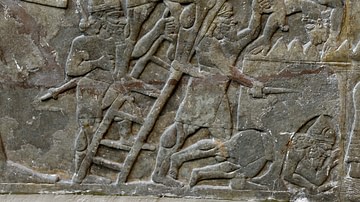
Assyrian Army Besieges a City
Alabaster bas-relief depicting an attack on a city by the Assyrian army. Detail of Panel 5 (bottom), Room B, the North-Palace Palace, Nimrud, modern-day Iraq, Neo-Assyrian Empire, 865-860 BCE.
The British Museum, London.
Image
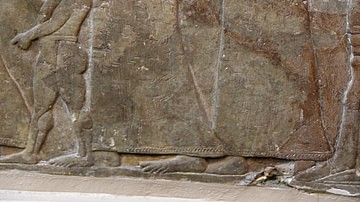
Assyrian Prisoners of War
Alabaster bas-relief showing two women and a child as prisoners of war after the Assyrian army captured their city, detail of Panel 5 (bottom), Room B, the North-Palace Palace, Nimrud, modern-day Iraq, Neo-Assyrian Empire, 865-860 BCE. The...
