
Search
Remove Ads
Advertisement
Search Results
Image
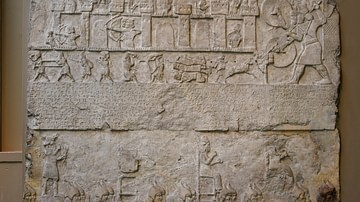
Assyrian Military Campaign Against Syria
Assyrian wall panel from the Central Palace at Nimrud (ancient Kalhu), Mesopotamia, Iraq, reused later in the South-West Palace, from the reign of Tiglath-Pileser III, c. 728 BCE. The panel, one of a series, shows 2 disconnected scenes...

Video
A Short History of Assyria and the Neo-Assyrian Empire
Assyria has a long history, beginning in northern Mesopotamia and then expanding during the Neo-Assyrian Empire from Mesopotamia through Asia Minor, and down through Egypt. The empire began in the city of Ashur and went through many different...

Definition
Mesopotamian Warfare - Early Development of Armed Conflict
Ancient Mesopotamian warfare progressed from companies of a city's militia in Sumer to the professional standing armies of Akkad, Babylon, Assyria, and Persia, and from conflicts over land or water rights to wars of conquest and political...

Image
Map of the Iron Age La Tène Culture c.400 BCE - c.50 CE
This map illustrates the extent of the La Tène culture, a key phase of the European Iron Age that flourished from around 450 BCE until the Roman conquests in the 1st century BCE. It highlights the widespread influence of early Celtic societies...
Image
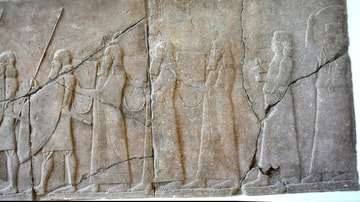
Assyrian Wall Relief Depicting Musical Instruments
Alabaster bas relief depicting marching shield bearers accompanied by a group of musicians who carry different musical instruments, from Nineveh, northern Mesopotamia, Iraq, Neo-Assyrian Empire, reign of king Sennacherib, 705-681 BCE. The...

Image
Assyrian War Relief Panel, Nimrud
Alabaster bas-relief showing Assyrian soldiers playing catch with decapitated heads of their enemies. Neo-Assyrian Period, 865-860 BCE. Detail of Panel 6 (top), Room B, the North-Palace Palace, Nimrud, modern-day Iraq. (The British Musuem...
Image
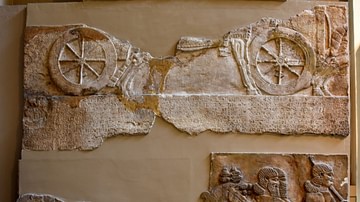
Assyrian Chariots
Assyrian wall panel, from the Central Palace at Nimrud (ancient Kalhu), Mesopotamia, modern-day Iraq, reused later in the South-West Palace, from the reign of Tiglath-Pileser III, c. 728 BCE. One of a series, it shows two disconnected scenes...
Image
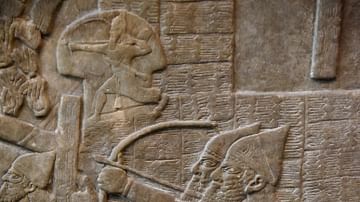
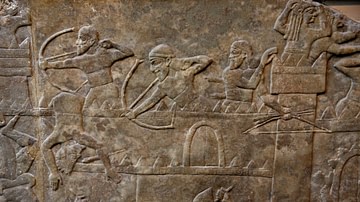
Assyrian Archers Attacking a City
Alabaster bas-relief depicting Assyrian archers attacking a city. Neo-Assyrian Period, 865-860 BCE. Detail of Panel 4 (bottom), Room B, the North-Palace Palace, Nimrud, modern-day Iraq. (The British Museum, London)
Image
Assyrian Army Assaulting a City
Alabaster bas-relief showing a massive and progressive Assyrian assault on a city. Neo-Assyrian Period, 865-860 BCE. Detail of Panel 4 (bottom), Room B, the North-Palace Palace, Nimrud, modern-day Iraq. (The British Museum, London)
Image
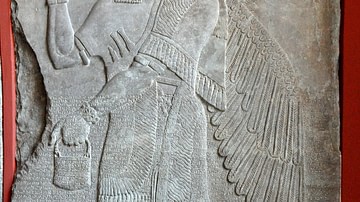
Assyrian Protective Spirit, Nimrud
Alabaster bas-relief, depicting a standing human-headed genie or sage, from the North-West Palace of Ashurnasirpal II at Nimrud, Mesopotamia, modern-day Iraq. Neo-Assyrian Empire, 9th century BCE. Apkallu, a protective spirit, protects the...
