
Search
Remove Ads
Advertisement
Search Results

Definition
Sarpedon
Sarpedon is a figure from ancient Greek mythology, a Lycian prince who was one of the principal heroes during the Trojan War and fought on the side of Troy. According to Homer's Iliad, he was the son of Zeus by Laodameia and the cousin...
Definition
Chimu Civilization
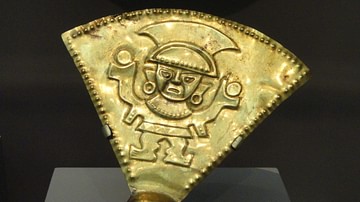
The Chimu civilization, otherwise called the kingdom of Chimor, flourished on the northern coast of Peru between the 12th and 15th centuries CE. With their capital at Chan Chan, the Chimu were the largest and most prosperous...

Definition
Crucifixion
Crucifixion as a punishment was practiced by several ancient cultures, but most notably adopted by the Roman Republic and later Roman Empire. Crucifixion was a method of hanging or suspending someone on the combination of vertical...

Definition
Movses Khorenatsi
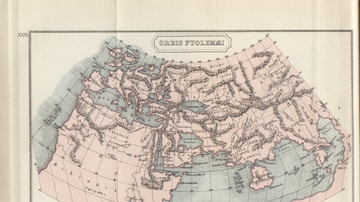
Movses Khorenatsi (Moses of Khoren) was a 5th-century CE Armenian historian whose work the History of the Armenians has earned him the title of the “father of Armenian history”. Drawing on ancient sources and ambitiously covering...
Definition
Arabia
The ancient Arabians, or Arabes as they were called by the Hellenes, were a Semitic people. One must note that the Arabians were not a single people but multiple smaller kingdoms and tribes. Arabia was home to great city builders and...

Definition
Gordium
Gordium was the capital of ancient Phrygia, modern Yassihüyük. It is situated on the place where the ancient Royal road between Lydia and Assyria/Babylonia crosses the river Sangarius, which flows from central Anatolia to the Black Sea...

Definition
Midas - The Mythical King with the Golden Touch
Midas was a mythical king of Phrygia in Asia Minor who was famous for his extraordinary ability to change anything he touched into gold. This gift was given to him by Dionysos in thanks for his hospitality...

Definition
Inanna - The Most Popular Goddess of Ancient Mesopotamia
Inanna is the ancient Sumerian goddess of love, sensuality, fertility, procreation, and also of war. She later became identified by the Akkadians and Assyrians as the goddess Ishtar, and further...

Definition
Hayasa-Azzi
The Hayasa-Azzi were an indigenous Bronze Age tribal confederation which flourished on the plateau of ancient Armenia and eastern Anatolia between c. 1500 and c. 1200 BCE. Although the historical record is impoverished and disputed...

Definition
Philistines
The Philistines populated the coastal regions of Canaan from the 12th century BCE to their disappearance in 604 BCE. The word "Philistine" derives from the Hebrew ha-Plištim for the combination of several tribes of Syria and Judea...
