
Search
Remove Ads
Advertisement
Search Results

Image
Assyrian Chariots in Phoenicia and the Storming of Khazazu
The upper register shows Assyrian chariots in Phoenicia while the lower register shows the storming of the city of Khazazu. Shalmaneser III's military campaign in Phoenicia, c. 859 BCE. Detail...

Image
Assyrian Female Musicians
Gypsum wall panel depicting two female musicians beside a palm tree. From the North Palace at Nineveh, Mesopotamia, modern-day Iraq. Neo-Assyrian Empire, reign of Ashurbanipal II, 660-650 BCE.
Pergamon Museum, Berlin.
Image
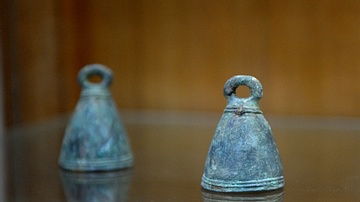
Assyrian Bells
These two bells were found in northern Mesopotamia. Neo-Assyrian period, 911-609 BCE. From Mesopotamia, Iraq. (The Sulaymaniyah Museum, Iraq)

Image
Yoked Captives from the City of Dabigu Under Assyrian Escort
This is the lower register (of two registers; the upper one is not shown) which shows yoked captives and their Assyrian escort. Shalmaneser III's military campaign in northern Syria, attack...

Image
Relief of a Neo-Assyrian Queen
Limestone stele fragment depicting a woman looking to the left and wearing a headdress of the royal women. From Kli'eh, near Haditha Dam, Al-Anbar Governorate, Iraq. Neo-Assyrian Empire, 911-612 BCE. The Iraq Museum...
Image
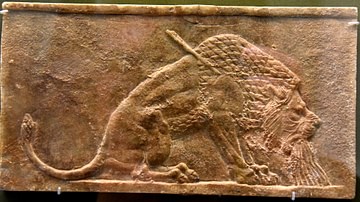
Assyrian Dying Lion
Detail of a much larger gypsum wall relief showing the climax of a royal lion hunt. The lion is shown in his final death throes, blood pouring from his mouth. From the North Palace of Ashurbanipal II at Nineveh, Mesopotamia...

Image Gallery
Marine Life in Ancient Mediterranean Art
Throughout the history of the ancient Mediterranean artists were always keen to express their appreciation of the bounty of the sea. Marine life of all kinds, real and imagined, was frequently depicted on frescoes...
Image
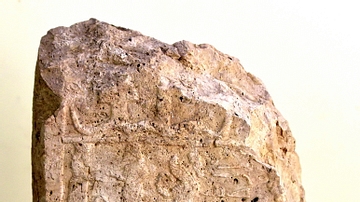
Assyrian Stele from Anat
This stele depicts three horizontal registers. The upper register depicts a snake and some symbols. The middle register depicts two standing male figures on the left and a rampant winged human-headed sphinx before some...

Image
Assyrian Arrowheads from Lachish
These bronze arrowheads were found at the city of Lachish. The city was besieged and then conquered by the Assyrian king Sennacherib in 701 BCE. (The British Museum, London).
Image
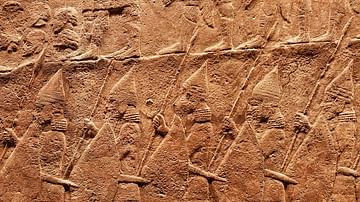
Assyrian Soldiers
Assyrian soldiers armed with shield, spear, and helmet (c. 700-692 BCE). They represent the army of King Sennacherib of Assyria (reigned 705-681 BCE) marching on Lachish, an ancient town about 40 km from Jerusalem. This image...
