
Search
Remove Ads
Advertisement
Search Results
Image
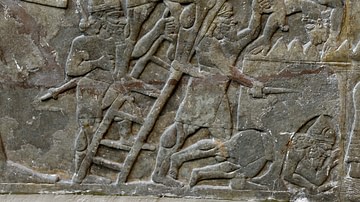
Assyrian Army Besieges a City
Alabaster bas-relief depicting an attack on a city by the Assyrian army. Detail of Panel 5 (bottom), Room B, the North-Palace Palace, Nimrud, modern-day Iraq, Neo-Assyrian Empire, 865-860 BCE. The British Museum, London...
Image
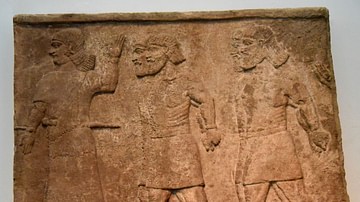
Review of Arab Prisoners, Assyrian Relief
Assyrian relief, from the Central Palace at Nimrud (ancient Kalhu), Mesopotamia, Iraq, Neo-Assyrian Empire, c. 728 BCE. This is part of a series of reliefs showing Arab prisoners brought before the Assyrian...
Image
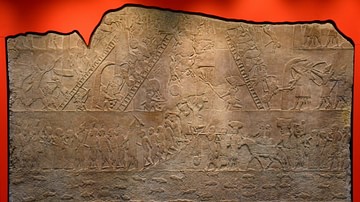
Assyrian Army Attacking Memphis
Gypsum panel showing the Assyrian army attacking the Egyptian city of Memphis and commemorating the final victory of the Assyrian king Ashurbanipal II over the Egyptian king Taharqa in 667 BCE. Panel 17, Room M of...
Image
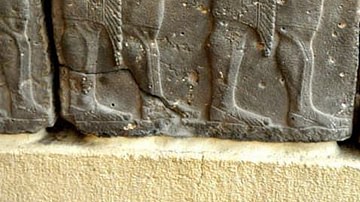
Assyrian Warriors Relief
Basalt reliefs depicting Assyrian warriors of different ranks in procession with a royal chariot led by the commander-in-chief of the Assyrian army. The reliefs were acquired and gathered during the years 1848, 1946, 1948...

Definition
Kalhu / Nimrud
Kalhu (also known as Caleh, Calah, and Nimrud, in modern-day northern Iraq) was a city in ancient Mesopotamia that became the capital of the Assyrian Empire under Ashurnasirpal II (r. 884-859 BCE) who moved the central government...

Definition
Ninurta - The Sumerian Hero-God of War
Ninurta (identified with Ningirsu, Pabilsag, and the biblical Nimrod) is the Sumerian and Akkadian hero-god of war, hunting, and the south wind. He first appears in texts in the early 3rd millennium BCE as an...

Image
High-Ranking Assyrian Officials
An almost 3-meter-high alabaster bas-relief depicting four high-ranking Assyrian officials or dignitaries, stepping forward to greet the Assyrian king, Sargon II. From the Royal Palace of Sargon II at Khorsabad, in...

Image
Map of the Assyria in the Middle Assyrian Period - Campaigns and Rival Powers in the Late Bronze Age
The Middle Assyrian period (c. 1365–1000 BCE) emerged from the shifting balance of power in the Late Bronze Age Near East. After earlier subordination to Mitanni...

Image
Map of the Rise and Expansion of the Neo-Assyrian Empire - Conquest and Imperial Power Across the Near East
The Neo-Assyrian Empire emerged from renewed Assyrian state-building in northern Mesopotamia during the early first millennium BCE. Under Adad-nirari II (reign...
Image
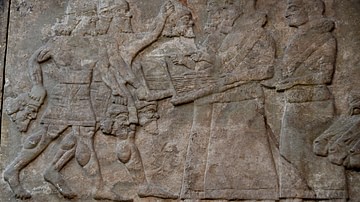
Decapitated Heads of Assyrian Enemies
Alabaster bas-relief showing Assyrian soldiers holding the decapitated heads of their defeated enemy before Assyrian musicians. Neo-Assyrian Period, 865-860 BCE. Detail of Panel 6 (top), Room B, the North-Palace...
