
Search
Remove Ads
Advertisement
Search Results

Definition
Mesopotamian Government - Helping and Serving the Gods
Ancient Mesopotamian government was based on the understanding that human beings were created to help and serve the gods. The high priest, king, assembly of elders, governors, and any other officials...

Image
Assyrian Soldiers Holding Decapitated Heads of Nubian Soldiers
Detail of a large gypsum wall panel, depicting the Assyrian attack on a fortress at the Egyptian city of Memphis in 667 BCE, Panel 17, Room M of the North Palace at Nineveh, Northern Mesopotamia...
Image
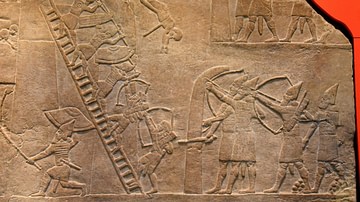
Assyrian Archers Attacking an Egyptian Fortress at Memphis
Detail of a large gypsum wall panel showing the Assyrian army attacking the Egyptian city of Memphis and commemorating the final victory of the Assyrian king Ashurbanipal II over the Egyptian...

Image
Assyrian Army Assault on Lachish
Assyrian relief, from the South-West palace at Nineveh (modern Kuyunjik, Mousil city, Iraq), room XXXVI, panel 7, Neo-Assyrian Empire, 700-692 BCE. This wall relief delivers a very vivid description of the battlefield...

Collection
The Art & Culture of Ancient Greece
The ancient Greeks were masters at picking up ideas from other cultures, mixing these with their own innovations and producing unique contributions to world culture. Greek sculptors adored the human form, painters...

Definition
Mesopotamian Warfare - Early Development of Armed Conflict
Ancient Mesopotamian warfare progressed from companies of a city's militia in Sumer to the professional standing armies of Akkad, Babylon, Assyria, and Persia, and from conflicts over land or water...

Definition
Ancient Syria
Syria is a country located in the Middle East on the shore of the Mediterranean Sea and bordered, from the north down to the west, by Turkey, Iraq, Jordan, Israel, and Lebanon. It is one of the oldest inhabited regions in the world...

Definition
Esarhaddon
Esarhaddon (r. 681-669 BCE) was the third king of the Sargonid Dynasty of the Neo-Assyrian Empire. He was the youngest son of King Sennacherib (r. 705-681 BCE), and his mother was not the queen but a secondary wife, Zakutu (also known...
Image
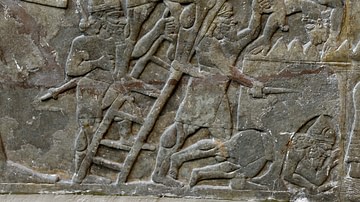
Assyrian Army Besieges a City
Alabaster bas-relief depicting an attack on a city by the Assyrian army. Detail of Panel 5 (bottom), Room B, the North-Palace Palace, Nimrud, modern-day Iraq, Neo-Assyrian Empire, 865-860 BCE. The British Museum, London...
Image
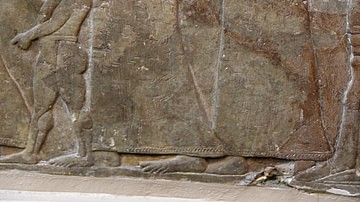
Assyrian Prisoners of War
Alabaster bas-relief showing two women and a child as prisoners of war after the Assyrian army captured their city, detail of Panel 5 (bottom), Room B, the North-Palace Palace, Nimrud, modern-day Iraq, Neo-Assyrian Empire...
