
Search
Did you mean: Zorvanism?
Remove Ads
Advertisement

 This answer was generated by
 Search Results

Definition
Basil the Great
Saint Basil (c. 330 - c. 379 CE), also known as Basil the Great and Basil of Caesarea, was a bishop of Caesarea in central Asia Minor who staunchly defended the church against the 4th-century CE heresy of Arianism. Basil's writings...

Article
Mavia's Revolt & the Christian Question
In 378 CE the Tanukhid queen Mavia (r. c. 375 - c. 425 CE) of the Saracens led a successful revolt against the Roman Empire, pitting her forces against the armies under the emperor Valens (364-378 CE). Launching...

Definition
Trinity
The Christian doctrine of the Trinity (from the Latin trinus, meaning "threefold") professes that there is one God, but three eternal and consubstantial persons (aspects): the Father, the Son, and the Holy Spirit. The Father is the God...
Definition
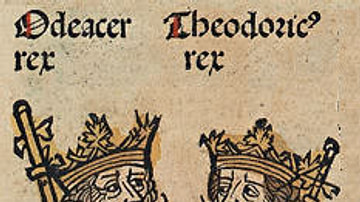
Theodoric the Great
Theodoric the Great (l. c. 454-526 CE, r. 493-526 CE, also known as Flavius Theodoricus) was the king of the Ostrogoths who, at the encouragement and direction of the Roman emperor Zeno, invaded Italy, deposed King Odoacer...

Definition
Council of Chalcedon
The Council of Chalcedon was called in 451 CE by the Roman Emperor Marcian (r. 450-457) to settle debates regarding the nature (hypostases, "reality") of Christ that had begun at two earlier meetings in Ephesus (431 CE and...

Image
Map of the Growth of Christianity in the Roman Empire - From Early Communities to Imperial Christianity, 30–451
The growth of Christianity in the Roman Empire from the 1st to the 5th centuries transformed a small religious movement rooted in Roman Judaea into one...

Definition
Constantinople
Built in the seventh century BCE, the ancient city of Byzantium proved to be a valuable city for both the Greeks and Romans. Because it lay on the European side of the Strait of Bosporus, the Emperor Constantine understood its...

Definition
Franks
The Franks were a Germanic people who originated along the lower Rhine River. They moved into Gaul during the Migration Age, where they established one of the largest and most powerful kingdoms in Europe after the fall of the Western...

Definition
Constantine I
Constantine I, aka Constantine the Great, was Roman emperor from 306 to 337 CE. Realizing that the Roman Empire was too large for one man to adequately rule, Emperor Diocletian (284-305 CE) split the empire into two, creating a...

Definition
Cathars
The Cathars (also known as Cathari from the Greek Katharoi for “pure ones”) were a dualist medieval religious sect of Southern France which flourished in the 12th century and challenged the authority of the Catholic Church. They were...
