
Search
Did you mean: Apollo?
Search Results

Article
The Mesopotamian Pantheon
The gods of the Mesopotamian region were not uniform in name, power, provenance or status in the hierarchy. Mesopotamian culture varied from region to region and, because of this, Marduk should not be regarded as King of the Gods in the same...
Image
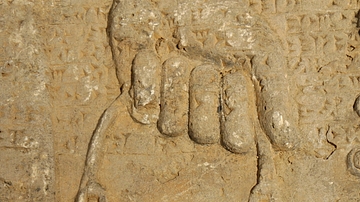
Assyrian Ceremonial Bucket (Banduddu)
This is a close-up image of an Assyrian bucket (banduddu) held by a protective spirit (Apkallu). During certain ceremonies, this bucket was filled with a fluid and the Apkallu dips a pine cone (mullilu) into it; the Apkallu then sprinkles...
Image
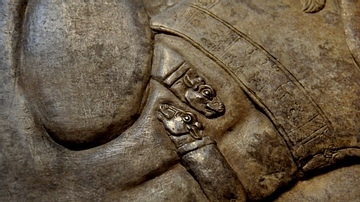
Assyrian Armlet
A close-up view of the right arm of a human-headed and winged protective spirit, Apkallu (or Sage). There is an armlet which embraces the right biceps muscle. The armlet's ends are sheep-headed. Note the decorations on the lower end of the...
Image
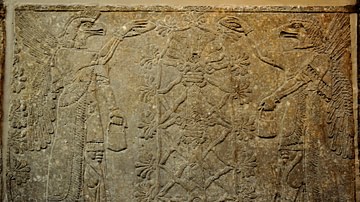
Eagle-Headed Apkallus Flanking the Sacred Tree
Alabaster bas-relief of eagle-headed Apkallus flanking the sacred tree. Neo-Assyrian Period, 865-860 BCE. Room I, the North-West Palace at Nimrud, modern-day Iraq. (The British Museum, London)
Image
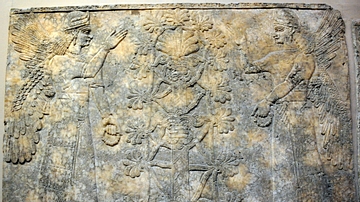
Female Apkallus Flanking the Scared Tree
Alabaster bas-relief showing female Apkallus flanking the sacred tree. Neo-Assyrian Period, 865-860 BCE. Panel 16, Room I, the North-West Palace at Nimrud, modern-day Iraq. (The British Museum, London)

Image
Ashurnasirpal II Prays Before the Sacred Tree and the God Shamash
The Assyrian king appears to raise his right hand and point his right index finger in a gesture of worship. He holds a mace, the symbol of authority. The Sacred Tree (which is probably a palm tree) lies at the middle of the relief. The king...
Image
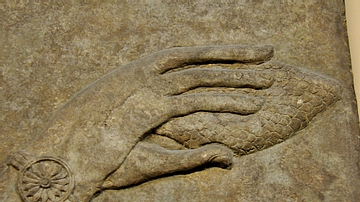
Assyrian Mullilu
This is a close-up image of a hand carrying an Assyrian mullilu; mullilu is an Akkadian word which means a purifier. This object, most likely a pine cone, was dipped into a certain liquid and then sprinkled on the Assyrian king and his courtiers...
Image
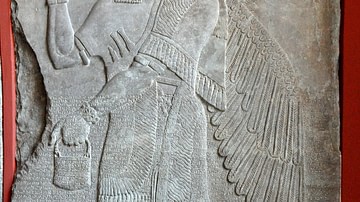
Assyrian Protective Spirit, Nimrud
Alabaster bas-relief, depicting a standing human-headed genie or sage, from the North-West Palace of Ashurnasirpal II at Nimrud, Mesopotamia, modern-day Iraq. Neo-Assyrian Empire, 9th century BCE. Apkallu, a protective spirit, protects the...
Image
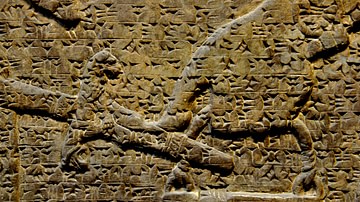
Standard Inscription of King Ashurnasirpal II
A close-up of the "Standard Inscription" of the Assyrian king Ashurnasirpal II, from the North-West palace at Nimrud (ancient Kalhu; biblical Calah), northern Mesopotamia, modern-day Iraq, Neo-Assyrian Empire, 865-860 BCE. The British Museum...
Article
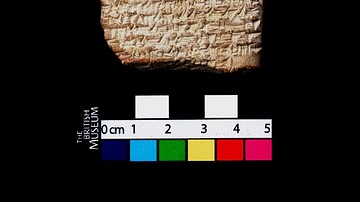
The Myth of Adapa
The Myth of Adapa (also known as Adapa and the Food of Life) is the Mesopotamian story of the Fall of Man in that it explains why human beings are mortal. The god of wisdom, Ea, creates the first man, Adapa, and endows him with great intelligence...
