
Search
Remove Ads
Advertisement
Search Results

Definition
Persian Rose-and-Nightingale Paintings
Rose-and-nightingale paintings and patterns (gul-u-bulbul) are a subtheme of the bird-flower (gul-u-morḡ) genre in Persian art. Bird-and-flower paintings are of Chinese origin and include pictorial elements such...

Definition
Roman Empire
The Roman Empire, at its height (c. 117), was the most extensive political and social structure in western civilization. Building upon the foundation laid by the Roman Republic, the empire became the largest and most powerful political...

Article
Eunuchs in Ancient China
Eunuchs were powerful political players in ancient Chinese government. Originating as trusted slaves in the royal household they were ambitious to use their favoured position to gain political power. Advising the emperor...

Definition
Chang'an
Chang'an, located near modern Xian in Shaanxi Province, was the capital of several dynasties of ancient China from the Zhou to the Tang and eventually became one of the world's great metropolises. With regular tree-lined avenues, high...

Definition
Sasanian Empire
The Sasanian Empire (224-651 CE, also given as Sassanian, Sasanid or Sassanid) was the last pre-Islamic Persian empire, established in 224 CE by Ardeshir I, son of Papak, descendant of Sasan. The Empire lasted until 651 CE when...

Definition
Mongol Empire
The Mongol Empire (1206-1368) was founded by Genghis Khan (r. 1206-1227), first Great Khan or 'universal ruler' of the Mongol peoples. Genghis forged the empire by uniting nomadic tribes of the Asian steppe and creating a devastatingly...

Definition
Shi Huangdi
Shi Huangdi (l.259-210 BCE/r.221-210 BCE, also known as Qin Shi Huang, Qin Shih Huandi, Shi Huangti or Shih Huan-ti) was the first emperor of a unified China. Shi Huangdi means `First Emperor' and is a title, not a proper name. The...

Definition
Wu Zetian
Empress Wu Zetian (Empress Consort Wu, Wu Hou, Wu Mei Niang, Mei-Niang, and Wu Zhao, l. 624-705 CE, r. 690-704 CE) was the only female emperor of Imperial China. She reigned during the Tang Dynasty (618-907 CE) and was one of the most...
Definition
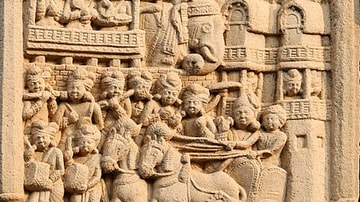
Ajatashatru
Ajatashatru (c. 493/492 BCE - c. 462/460 BCE) was the second important king of the Haryanka Dynasty, who came to the throne of Magadha by deposing and executing his own father Bimbisara. The Haryanka Dynasty (c. 545/544 BCE - c. 413...

Definition
Ptolemaic Egypt
Ptolemaic Egypt existed between 323 and 30 BCE when Egypt was ruled by the Macedonian Ptolemaic dynasty. During the Ptolemaic period, Egyptian society changed as Greek immigrants introduced a new language, religious pantheon...
