
Search
Remove Ads
Advertisement
Search Results

Image
Tiglath-pileser III, Submission of Enemy
An alabaster bas-relief depicting the Assyrian king Tiglath-pileser III stands over a captured enemy. The cuneiform inscription describes an Assyrian campaign in Iran 744 BCE. From the central palace at Nimrud...

Image
A Wall Relief from Tiglath-Pileser III's Palace
A man holds a mace and a bow and a number of cows appear behind him. The name of the man is unknown. A fragment of a limestone wall relief from the palace of Tiglath-pileser III at Nimrud (ancient Kalhu...

Image
Head of Senusret III
Granite head from a sphinx of the Egyptian pharaoh Senusret III with youthful features. Egypt. Middle Kingdom, 12th Dynasty, 1870 BCE. (State Museum of Egyptian Art, Munich, Germany).

Image
The Black Obelisk of Shalmaneser III, side A, upper register
The Assyrian king Shalmaneser III, holding a bow, receives a tribute from Sua the Gilzanean. The king faces his field marshal and another official.From Nimrud, (ancient Kalhu), near the building...

Image
Tiglath Pileser III
Detail of a gypsum wall relief showing the Assyrian king Tiglath Pileser III from the South-West palace at Nimrud, Mesopotamia, modern-day Iraq, Neo-Assyrian Empire, 745-727 BCE. The king is recognizable by his long beard...

Definition
Middle Kingdom of Egypt - Ancient Egypt's Classical Age
The Middle Kingdom (2040-1782 BCE) is considered ancient Egypt's Classical Age, during which it produced some of its greatest works of art and literature. Scholars remain divided on which dynasties...

Image
Tomb Relief of Amenhotep III
This limestone relief of the Egyptian pharaoh Amenhotep III (c. 1386-1353 BCE) came from the Tomb (TT57) of Khaemhat at Western Thebes (in modern-day Sheikh Abd el-Qurna), Egypt. Amenhotep III was depicted in profile...
Image
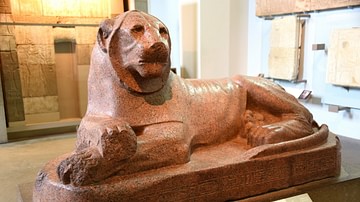
King Amenhotep III as a Lion
Statue of Amenhotep III, declares the king's might by representing him as a lion, from Napata (Gebel Barkal, Sudan), originally from Soleb (Sudan), 18th Dynasty, reign of Amenhotep III, 1390-1352 BCE. Pharaohs were...

Image
Two Statues of Shalmaneser III at the Iraq Museum
In the centre of this image is the so-called Kurba'il statue of Shalmaneser III (reigned 858-824 BCE), which was found in Fort Shalmaneser in 1961 CE by the British School of Archaeology in Iraq. The...
Image
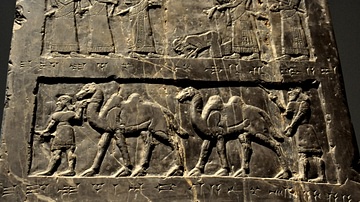
The Black Obelisk of Shalmaneser III, side A, 3rd register
Attendants bring tribute from Musri with two-humped camels. Musri, meaning a borderland, probably refers to a country in eastern Iran or in Egypt. From Nimrud, (ancient Kalhu), near the building...
