
Search
Remove Ads
Advertisement
Search Results

Article
Ai Khanum, the Capital of Eucratides
Ai Khanum (also spelled Ai-Khanoum or Ay-Khanum, lit. “Lady Moon” in Uzbek), was founded in the 4th century BC, following the conquests of Alexander the Great and was one of the primary cities of the Greco-Bactrian...

Article
Weapons in Ancient Egypt
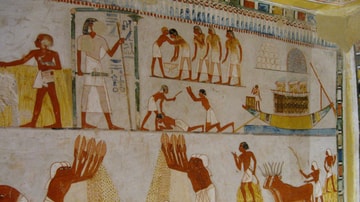
The ancient Egyptian military is often imagined in modern films and other media as a heavily armed and disciplined fighting force equipped with powerful weapons. This depiction, however, is only true of the Egyptian army...
Article
Social Structure in Ancient Egypt
The society of ancient Egypt was strictly divided into a hierarchy with the king at the top and then his vizier, the members of his court, priests and scribes, regional governors (eventually called 'nomarchs'), the...

Article
The Royal Macedonian Tombs at Vergina
Excavations at Vergina in northern Greece in the late 1970s CE unearthed a cluster of tombs thought to be the burial site of Philip II (r. 359-336 BCE), the father of Alexander the Great (r. 336-323 BCE), with...

Article
Mesopotamian Effects on Israel During the Iron Age
The Iron Age in the traditional Ancient Near Eastern chronology ranges from somewhere around 1200 BCE to 333 BCE. It begins from the era when it was first thought iron came to be used up to the ascendency...

Definition
William II of England
William II of England, sometimes called William 'Rufus' for his red hair and complexion, reigned as the king of England from 1087 to 1100 CE. The son of William the Conqueror (r. 1066-1087 CE), the younger William was loyal...

Definition
Byzantine Empire
The Byzantine Empire existed from 330 to 1453. It is often called the Eastern Roman Empire or simply Byzantium. The Byzantine capital was founded at Constantinople by Constantine I (r. 306-337). The Byzantine Empire varied in...

Definition
Medieval Chivalry
In medieval Europe, a code of ethics known as chivalry developed which included rules and expectations that the nobility would, at all times, behave in a certain manner. Chivalry was, in addition, a religious, moral and social...

Definition
William the Conqueror
William the Conqueror (c. 1027-1087), also known as William, Duke of Normandy, led the Norman Conquest of England in 1066 when he defeated and killed his rival Harold Godwinson at the Battle of Hastings. Crowned King William...

Definition
Sir William Marshal - England's Greatest Knight
The Englishman Sir William Marshal (c. 1146-1219 CE, aka William the Marshal), Earl of Pembroke, is one of the most celebrated knights of the Middle Ages. Renowned for his fighting skills, he remained undefeated...
