
Search
Remove Ads
Advertisement
Search Results

Definition
The Seven Wonders
The Seven Wonders of the Ancient World were seven impressive structures famously listed by ancient writers including Philo of Byzantium, Antipater of Sidon, Diodorus Siculus, Herodotus, Strabo, and Callimachus of Cyrene, among...

Definition
Hellenistic Astrology
Hellenistic astrology encompassed various forms of divination in Greece and the Mediterranean, all linked to the observation of astronomical phenomena. Hellenistic astrology was based on the belief that the stars and planets...

Definition
Artaxerxes I
Artaxerxes I (r. 465-424 BCE) was the sixth monarch of the Achaemenid Persian Empire. He was the son of Xerxes I (r. 486-465 BCE) and his principal wife Amestris (d. 424 BCE) and grandson of Darius I (the Great, r. 522-486 BCE...

Definition
Arsinoe II Philadelphus
Arsinoe II (l. c. 318/311 - c. 270/268 BCE), daughter of Ptolemy I became one of the most enduring figures of the Lagid or Ptolemaic Dynasty and left an undeniable mark in the historical evidence. She was married three times...
Definition
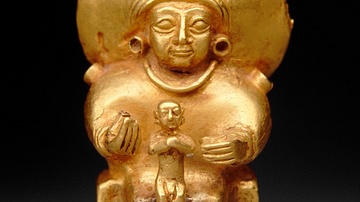
Sauska - The Hurrian's Radiant Goddess of Fertility and War
Sauska (also known as Shaushka, Sausga, and Anzili) was the Hurrian-Hittite goddess of fertility, war, and healing. She was worshipped throughout the region known as Hanigalbat (present day Iraq...

Article
Our Favourite Ancient History Shops
World History Encyclopedia’s main mission is to engage people with cultural heritage and to improve history education worldwide. We are achieving this through our definitions and articles, our videos and education...

Definition
Hanging Gardens of Babylon
The Hanging Gardens of Babylon were the fabled gardens which beautified the capital of the Neo-Babylonian Empire, built by its greatest king Nebuchadnezzar II (r. 605-562 BCE). One of the Seven Wonders of the Ancient World...

Article
The Spread of Islam in Ancient Africa
Following the conquest of North Africa by Muslim Arabs in the 7th century CE, Islam spread throughout West Africa via merchants, traders, scholars, and missionaries, that is largely through peaceful means whereby...

Definition
Antinous
Antinous (l. c. 110-130 CE) was a youth of Bithynia who became the beloved of the Roman emperor Hadrian (l. 76-138 CE, r. 117-138 CE) from around the age of 13 until his death at nearly 20. His year of birth is unknown as are any details...

Article
Dogs & Their Collars in Ancient Rome
Dogs were highly valued in ancient Rome, as they were in other cultures, and the Roman dog served many of the same purposes as it did in, say, Egypt and Persia - as hunters, guardians, and companions - but with...
