
Search
Remove Ads
Advertisement
Search Results

Definition
Suppiluliuma I
Suppiluliuma I (1344-1322 BCE) is considered the most powerful and impressive king of the Hittite Empire. He was the son of Tudhaliya II (also known as Tudhaliya III) and is credited with founding the New Kingdom of the Hittites...

Definition
Second Crusade
The Second Crusade (1147-1149) was a military campaign organised by the Pope and European nobles to recapture the city of Edessa in Mesopotamia which had fallen in 1144 to the Muslim Seljuk Turks. Despite an army of 60,000 and...

Definition
Joan I of Navarre - Queen Consort of France
Joan I of Navarre (1273-1305) served as queen of Navarre and countess of Champagne and Brie between 1274 and 1305. In 1285, she also became queen consort of France following her marriage to Philip IV of France...

Definition
Order of the Garter
The Most Noble Order of the Garter is the highest order of knighthood in Britain and the most exclusive with traditionally only 24 knights as full members at any one time, along with the reigning monarch and the Prince of Wales...

Definition
James IV of Scotland
James IV of Scotland ruled as king from 1488 to 1513. He succeeded his father James III of Scotland (r. 1460-1488) and became one of the most popular of the Stuart kings. James sought to apply justice in every corner of his...

Definition
Henry VI of England
Henry VI of England ruled as king from 1422 to 1461 and again from 1470 to 1471. Succeeding his father Henry V of England (r. 1413-1422), Henry VI was crowned the king of France in 1431 but he could not prevent a French revival...

Definition
Urartu Civilization
Urartu, also known as the Kingdom of Urartu or the Kingdom of Van, was a civilization which developed in the Bronze and Iron Age of ancient Armenia, eastern Turkey, and northwestern Iran from the 9th century BCE. Controlling...

Definition
Byzantine Emperor
The Byzantine Emperor ruled as an absolute monarch in an institution which lasted from the 4th to 15th century CE. Aided by ministers, high-ranking nobility, and key church figures, the emperor (and sometimes empress) was commander-in-chief...

Definition
Byzantine Coinage
The coinage of the Byzantine Empire continued that of its more ancient predecessors and functioned as a convenient method of payment for goods and services, especially to soldiers and officials, and as a means for people to pay...
Article
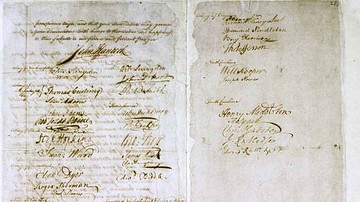
Olive Branch Petition
The Olive Branch Petition was a letter adopted by the Second Continental Congress on 5 July 1775 and sent to King George III of Great Britain (r. 1760-1820) in a final attempt at reconciliation in the early months of the American...
