
Search
Remove Ads
Advertisement

 This answer was generated by
 Search Results

Definition
God's Wife of Amun
The position of God's Wife of Amun was one of the most politically powerful and spiritually significant in later Egyptian history. Elevated from a figurehead in the New Kingdom (c.1570-1069 BCE), the God's Wife of Amun would...

Definition
Second Intermediate Period of Egypt - The Era of the Hyksos
The Second Intermediate Period (circa 1782 to circa 1570 BCE) is the era following the Middle Kingdom of Egypt (2040-1782 BCE) and preceding the New Kingdom (circa 1570-1069 BCE). As with all...

Definition
Egyptian Empire
The Egyptian Empire rose during the period of the New Kingdom (c. 1570- c. 1069 BCE), when the country reached its height of wealth, international prestige, and military might. The empire stretched from modern-day Syria in the...

Image
Ahmose-Nefertari
Rectangular fragment of a polychrome tomb-painting representing Ahmose-Nefertari standing among foliage with cartouche above.
20th Dynasty, Tomb of Kynebu, Thebes, Egypt.
British Museum, London.
Image
Queen Ahmose-Merytamun
The cobra emblem on the forehead and the Hathoric wig confirms this is a queen. Just as pharaohs were deemed an incarnation of Horus, so did queens embody the goddess Hathor. Ahmose-Merytamun was a sister and wife of Amenhotep...
Image
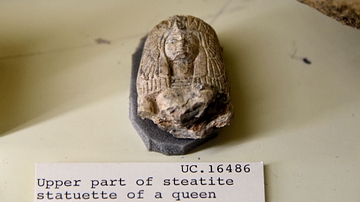
Statuette of Queen AHMOSE-NEFERTARI
This is the upper part of steatite figurine of queen AHMOSE-NEFERTARI, the patroness of the Theban Necropolis. She wears the vulture headdress. From Egypt, precise provenance of excavation is unknown. 19th Dynasty...

Definition
Hyksos - The Rulers of Foreign Lands Who Transformed Egypt
The Hyksos were a West Semitic-speaking people who gained a foothold in Egypt circa 1782 BCE at the city of Avaris in Lower Egypt, thus initiating the era known in Egyptian history as the Second...

Definition
Amun
Amun (also Amon, Ammon, Amen, Amun-Ra) is the ancient Egyptian god of the sun and air. He is one of the most important gods of ancient Egypt who rose to prominence at Thebes at the beginning of the period of the New Kingdom (c. 1570-1069...

Article
Conflict Between the Temple and the Crown in Ancient Egypt
The gods of ancient Egypt were worshipped as the creators and sustainers of all life. People acknowledged their supremacy and intimacy daily through rituals, amulets, and their labor for the king...

Definition
Canaan
Canaan was the name of a large and prosperous ancient country (at times independent, at others a tributary to Egypt) located in the Levant region of present-day Lebanon, Syria, Jordan, and Israel. It was also known as Phoenicia. The origin...
