
Search
Remove Ads
Advertisement
Search Results

Definition
William Brewster
William Brewster (l. 1568-1644 CE) was an elder of the Leiden congregation of separatists (later known as pilgrims) and their spiritual leader while onboard the Mayflower and later after the establishment of the Plymouth Colony...
Definition
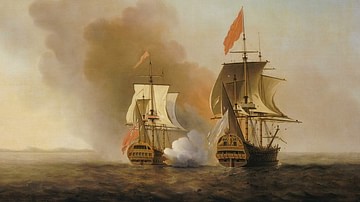
Galleon
The galleon (Spanish: galeón, French: galion) was a type of sailing ship used for both cargo carrying and as a warship. Galleons dominated the seas in the second half of the 16th century, and with their lower superstructures, they were...

Definition
Paul Cézanne
Paul Cézanne (1839-1906) was a French post-impressionist artist. Although he struggled for recognition in his own lifetime and often lacked confidence in his work, the artist's unique style, use of light and colour, and his interest...

Definition
Emperor Xuanzong of Tang
Xuanzong (birth name, Li Longji, l. 685-762 CE, r. 712-756 CE) was the 7th emperor of the Tang Dynasty of China, whose domestic and foreign policies established the Tang Dynasty as the Golden Age in Chinese history. Many...

Definition
Bede
Bede (c. 673-735 CE) was an English monk, historian, and scholar who lived in the Kingdom of Northumbria. He is at times referred to as the Venerable Bede or Bede the Venerable. He was a monk at the double monastery of Monkwearmouth-Jarrow...

Definition
Ragnarök - The Cataclysmic Battle of Norse Mythology
Ragnarök is the cataclysmic battle between the forces of chaos and those of order in Norse mythology, ending the world and killing most of the gods and their adversaries, leading to the birth of a new...

Definition
Agamemnon (Person)
Agamemnon was the legendary king of Mycenae and leader of the Greek army in the Trojan War of Homer's Illiad. Agamemnon is a great warrior but also a selfish ruler who famously upset his invincible champion Achilles, a feud...

Definition
Western Astrology
Western astrology refers to a form of divination based on the motion of astronomical objects such as stars or planets. The belief that astronomical objects are divine or influence events on Earth is found in many cultures, but...

Definition
Cuneiform - The Writing System That Made History
Cuneiform is a system of writing first developed by the ancient Sumerians of Mesopotamia circa 3600/3500 BCE. It is considered the most significant among the many cultural contributions of the Sumerians...

Definition
Pylos
Pylos was a significant Mycenaean Bronze Age city located in the region of Messenia, Greece. The site is situated on the hill of Ano Englianos and during its Late Bronze Age occupation between c. 1600-1200 BCE it covered a maximum area...
