
Search
Remove Ads
Advertisement
Search Results
Image
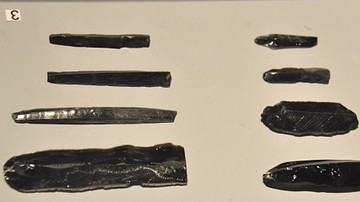
Obsidian Tools
These tool were probably used for cutting and chopping. Obsidian is a naturally occurring volcanic glass and is not local to Mesopotamia. It was most likely imported from modern Afghanistan. These tools were found at Tell Shemshara...

Image Gallery
Reconstructions of Asian Castles
This high-definition gallery presents digital reconstructions of six iconic Asian castles, from Afghanistan to Japan. Many of these castles have taken damage since then due to wars, political instability, and even...
Image
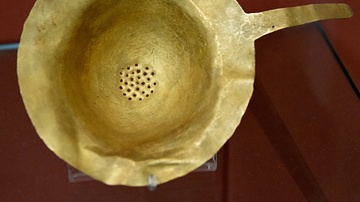
Mesopotamian Gold Strainer
This gold strainer was roughly shaped and has a short handle. It was found at the bottom of the pit of Queen Puabi's grave. Beer and wine were drunk in Mesopotamia from at least the fourth millennium BCE and it is possible...
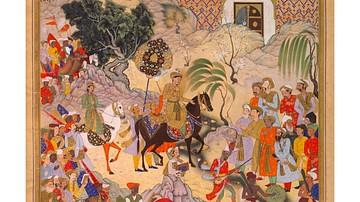
Image Gallery
A Gallery of Mughal Paintings
In this gallery, we present many fine examples of paintings from the Mughal Empire (1526-1857). Espoused and cultivated by the Mughal court, the artform married the bold styles of classical Indian miniature painting...

Book Review
Lost World of the Golden King: In Search of Ancient Afghanistan
This book deals mostly with historiography of the study of Central Asia in Ancient Times. The several phases and specialists of Greco-Bactrian and Indo-Greeks world are the main concern of...
Definition
Eucratidia
Eucratidia was a Greek town in Bactria, one of the easternmost area ever controlled by the Greeks, located at the modern site of Aï Khanum in North-Eastern Afghanistan. The history of this city is still rather unknown, but it seems...

Image
Hindu Kush Mountain Range
The Hindu Kush mountains at the Afghanistan-Pakistan border

Image
Shah Shuja
A portrait of Shah Shuja, King of the Afghan Empire from 1803 to 1809 and the proposed candidate to rule Afghanistan of the British East India Company during the First Anglo-Afghan War (1838-42). (National Army Museum, London)

Image
Cybele Plate
Plate found at Ai Khanum in northern Afghanistan, in a temple, depicting Cybele, a votive sacrifice and the sun God. 2nd century BCE. (Museé Guimet, Paris)

Image
The Khyber Pass by Rattray
An 1848 lithograph by James Rattray of the Khyber Pass (between today's Afghanistan and Pakistan).
