
Search
Did you mean: Adad Nirari I?
Remove Ads
Advertisement
Search Results

Definition
Henry VI of England
Henry VI of England ruled as king from 1422 to 1461 and again from 1470 to 1471. Succeeding his father Henry V of England (r. 1413-1422), Henry VI was crowned the king of France in 1431 but he could not prevent a French revival...

Definition
Order of the Garter
The Most Noble Order of the Garter is the highest order of knighthood in Britain and the most exclusive with traditionally only 24 knights as full members at any one time, along with the reigning monarch and the Prince of Wales...

Article
Causes of the Hundred Years' War
The Hundred Years' War (1337-1453) was an intermittent conflict fought between England and France that started when king Edward III of England (r. 1327-1377) squabbled with Philip VI of France (r. 1328-1350) over...
Article
Olive Branch Petition
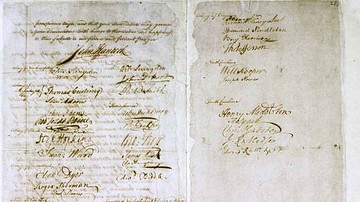
The Olive Branch Petition was a letter adopted by the Second Continental Congress on 5 July 1775 and sent to King George III of Great Britain (r. 1760-1820) in a final attempt at reconciliation in the early months of the American...

Article
Causes of the Wars of the Roses
The Wars of the Roses (1455-1487 CE) was a series of dynastic conflicts between the monarchy and the nobility of England. The 'wars' were a series of intermittent, often small-scale battles, executions, murders, and...

Definition
Nanna - Mesopotamian God of the Moon and Wisdom
Nanna (also known as Nannar, Nanna-Suen, Sin, Asimbabbar, Namrasit, Inbu) is the Mesopotamian god of the moon and wisdom. He is one of the oldest gods in the Mesopotamian pantheon and is first mentioned...

Article
The Nimrud Dogs - The Security System of Ancient Mesopotamia
The Nimrud Dogs, five clay canine figurines found at the ancient Mesopotamian city of Nimrud, were only a few of the many startling finds in the region in the 20th century. During the 19th century...

Definition
Byzantine Emperor
The Byzantine Emperor ruled as an absolute monarch in an institution which lasted from the 4th to 15th century CE. Aided by ministers, high-ranking nobility, and key church figures, the emperor (and sometimes empress) was commander-in-chief...

Definition
Byzantine Coinage
The coinage of the Byzantine Empire continued that of its more ancient predecessors and functioned as a convenient method of payment for goods and services, especially to soldiers and officials, and as a means for people to pay...

Definition
Urartu Civilization
Urartu, also known as the Kingdom of Urartu or the Kingdom of Van, was a civilization which developed in the Bronze and Iron Age of ancient Armenia, eastern Turkey, and northwestern Iran from the 9th century BCE. Controlling...
