
Search
Remove Ads
Advertisement
Search Results

Article
Women in Ancient Persia
Women in ancient Persia were not only highly respected but, in many cases, considered the equals of males. Women could own land, conduct business, received equal pay, could travel freely on their own, and in the case of...

Article
Ten Great Persian Poets
Persian literature derives from a long oral tradition of poetic storytelling. The first recorded example of this tradition is the Behistun Inscription of Darius I (the Great, r. 522-486 BCE), carved on a cliff-face c. 522...

Article
The Early History of Clove, Nutmeg, & Mace
The spices clove, nutmeg, and mace originated on only a handful of tiny islands in the Indonesian archipelago but came to have a dramatic, far-reaching impact on world trade. In antiquity, they became popular...
Article
Trade & Warfare in the Kievan Rus
Scandinavians from the island of Gotland began to spread throughout the Baltic region along the Russian rivers in the 700s. While the Vikings of Norway and Denmark from the 8th to 11th centuries are widely recognized...
Article
Middle Eastern Power Shifts & the Trade of Pepper from East to West
Pepper has long been the king of spices and for almost 2,000 years dominated world trade. Originating in India, it was known in Greece by the 4th century BCE and was an integral part of...

Article
The Style & Regional Differences of Seljuk Minarets in Persia
Under the Seljuk rule, Persia gained a period of economic and cultural prosperity. The innovative techniques of the Seljuk period and style in architecture and the arts had a strong influence...
Image
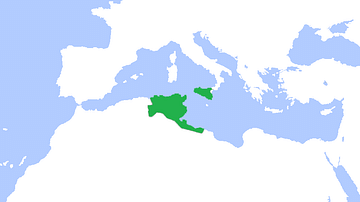
Map of Aghlabid Emirate
This is a map showing the greatest extent of the Aghlabids (800-909 CE).
Collection
Persian Poets and Literature
Persian literature is usually dated to the Behistun Inscription of Darius I (the Great, r. 522-486 BCE) at c. 522 BCE. It is generally understood that a significant body of work was created by Persian writers between...

Image
Map of the Rise of the Delhi Sultanate: The Mamluk Period - From Slave Commanders to Sultans
The Delhi Sultanate under the Mamluk (or “Slave”) Dynasty (1206–1290) marked the consolidation of centralized Muslim rule in northern India following the fragmentation...

Image
West Church, Umm el-Jimal (Jordan)
Ruins of the West Church found at the village of Umm el-Jimal in the north of Jordan, which was occupied between the 1st century CE (by the Kingdom of Nabatea) and the 9th century CE (during the Abbasid period...
