
Search
Remove Ads
Advertisement
Search Results

Definition
Berenike IV
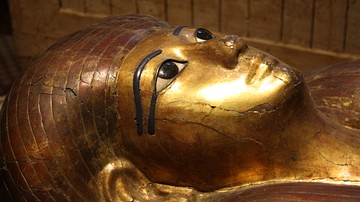
Berenike IV (r. 58-55 BCE) was queen of Ptolemaic Egypt and the older sister of Cleopatra VII (r. 51-30 BCE). She ruled briefly after her father Ptolemy XII was overthrown by a popular rebellion. Berenike IV's reign ended in 55 BCE...
Article
Herodotus on Burial in Egypt
Herodotus' section of his Histories on burial in ancient Egypt (Book II.85-90) is an accurate description of Egyptian mummification, but he purposefully omits the spiritual significance of embalming in keeping with his...

Definition
Moses
Moses (c. 1400 BCE) is considered one of the most important religious leaders in world history. He is claimed by the religions of Judaism, Christianity, Islam, and Bahai as an important prophet of God and the founder of monotheistic belief...

Definition
Confucianism
Confucianism is a philosophy developed in 6th-century BCE China, which is considered by some a secular-humanist belief system, by some a religion, and by others a social code. The broad range of subjects touched on by Confucianism...

Image
Tang Dynasty Glazed Ware
A burial vessel in the form of a flower, Sancal ware, mid-8th century CE, T'ang Dynasty. (Museum of Asian Art, Corfu)

Image
Tang Dynasty Greyhound
This figure of a greyhound was made in the area between China's Shaanxi and Henan provinces during the Tang Dynasty, around c. 750 CE. (Museum Rietberg, Zürich).

Image
Camel with Guide, Tang Dynasty
Lying camel with guide, China, Tang Dynasty, early 7th century CE. Made from stone with a white glaze. Exhibited at Museum Rietberg, Zurich, Switzerland.

Image
The Julio-Claudian Dynasty
The five Roman emperors of the Julio-Claudian dynasty. These were: - Augustus (r. 27 BCE - 14 CE) - centre photo - Tiberius (r. 14-37 CE) - top left - Caligula (r. 37-41 CE) - top right - Claudius (r. 41-54 CE...

Image
Jin Dynasty Stoneware Tray
A glazed stone tray, 12th century CE, Jin Dynasty. (Museum of Asian Art, Corfu)
Image
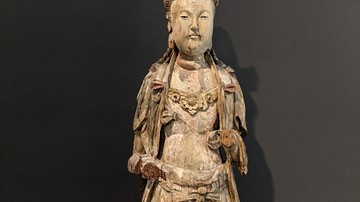
Guanyin, Song Dynasty
Guanyin, the Bodhisattva of Compassion. Song Dynasty (960-1279 CE), China. Wooden, painted and gilded. Exhibited at Museum Rietberg, Zurich, Switzerland.
