
Search
Remove Ads
Advertisement
Search Results

Article
Ancient Egyptian Taxes & the Cattle Count
The gods of ancient Egypt freely gave their bounty to the people who worked the land, but this did not exempt those farmers from paying taxes on that bounty to the government. Egypt was a cashless society until...
Article
Ancient Egyptian Symbols
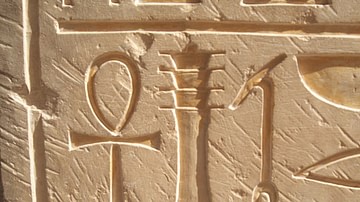
Religion in ancient Egypt was fully integrated into the people's daily lives. The gods were present at one's birth, throughout one's life, in the transition from earthly life to the eternal, and continued their care for...

Article
The Art of the Tang Dynasty
The art of the Tang Dynasty (618-907 CE) began to explore new possibilities in materials and styles with landscape painting and ceramics, in particular, coming to the fore. New techniques, a wider range of colours and...
Article
Grave Goods in Ancient Egypt
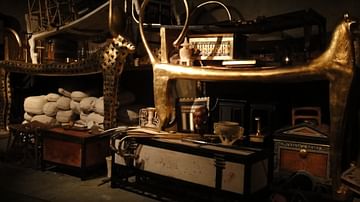
The concept of the afterlife changed in different eras of Egypt's very long history, but for the most part, it was imagined as a paradise where one lived eternally. To the Egyptians, their country was the most perfect...

Definition
Karnak
Karnak is the modern-day name for the ancient site of the Temple of Amun at Thebes, Egypt. The Egyptians called the site Nesut-Towi, "Throne of the Two Lands", Ipet-Iset, "The Finest of Seats" as well as Ipt-Swt, "Selected Spot" also...

Definition
Ptolemaic Police
Ptolemaic police, or phylakitai, were responsible for law enforcement throughout Ptolemaic Egypt. The existence of a professional police force made Egypt different from ancient societies like the Roman Empire, which had no police...

Definition
Ancient Egyptian Literature
Ancient Egyptian literature comprises a wide array of narrative and poetic forms including inscriptions on tombs, stele, obelisks, and temples; myths, stories, and legends; religious writings; philosophical works; wisdom...

Definition
Tutankhamun
Tutankhamun (also known as Tutankhamen and `King Tut', r. c.1336-c.1327 BCE) is the most famous and instantly recognizable Pharaoh in the modern world. His golden sarcophagus is now a symbol almost synonymous with Egypt. His name...

Definition
Ptolemy II Philadelphus
Ptolemy II Philadelphus ("The Sibling Loving", r. 282-246 BCE) was the second ruler of the Ptolemaic Dynasty. He consolidated the kingdom conquered by his father Ptolemy I and presided over its golden age. Ptolemy II invested...

Definition
Senusret III - Greatest Egyptian Monarch of the Middle Kingdom
Senusret III (circa 1878-1839 BCE, also known as Senwosret III, Sesostris III) was the 5th king of the 12th Dynasty of the Middle Kingdom of Egypt (2040-1782 BCE). His reign is often considered...
