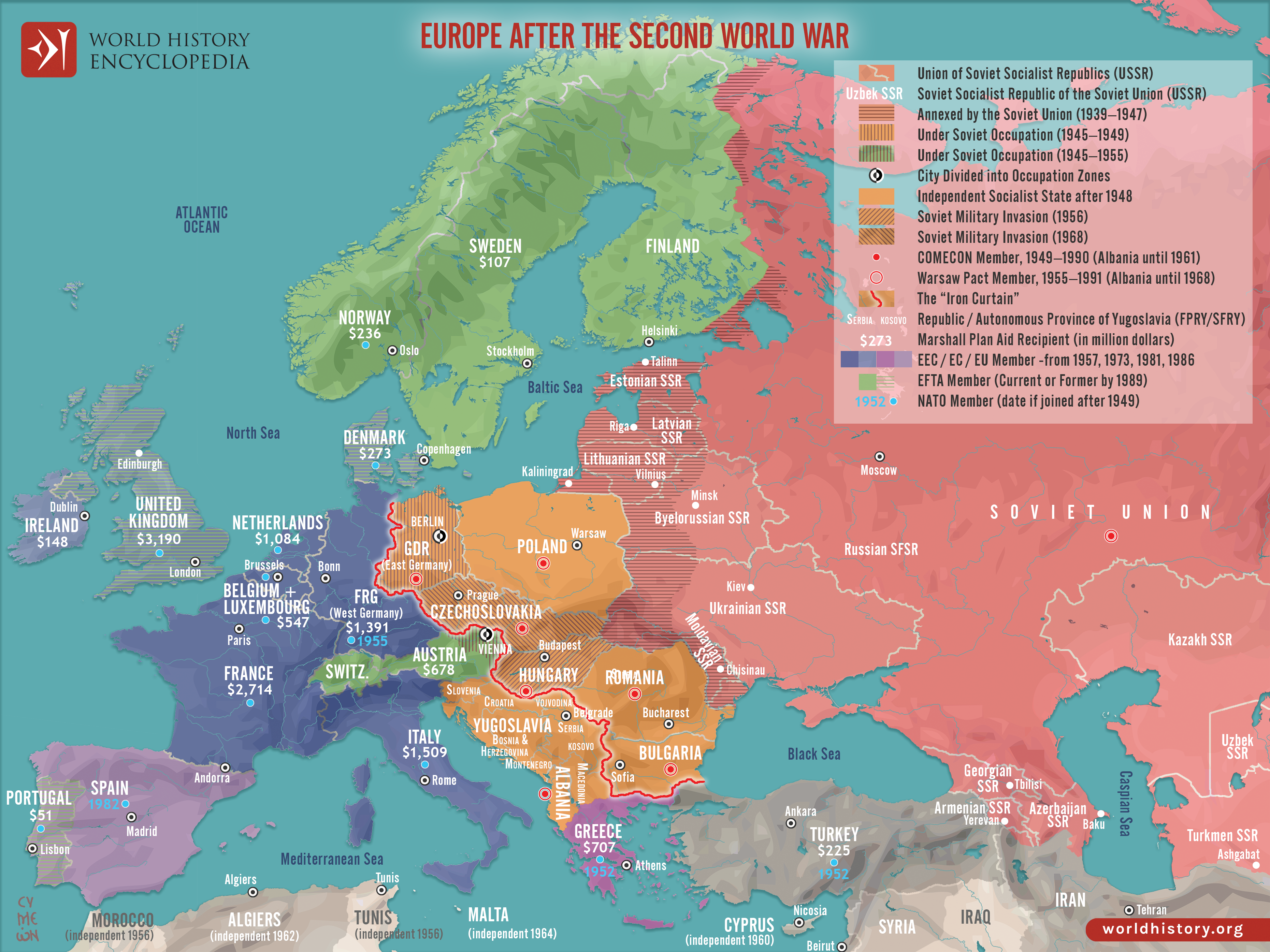
Map of Europe After World War II (1945 to c. 1989)

In the aftermath of the Second World War (1939–1945), Europe emerged physically devastated and politically polarized. As Allied cooperation gave way to rivalry between the United States and the Soviet Union under Joseph Stalin (rule 1924–1953), the continent became divided into competing spheres of influence. Western European states aligned with the United States, while Central and Eastern Europe fell under Soviet-backed communist governments. This division was not merely ideological but institutional, reshaping economic systems, security structures, and diplomatic alignments in what became known as the Cold War (c. 1947–1991).
To stabilize Western Europe and limit the appeal of communism, the United States implemented the Marshall Plan (1948–1952), channeling financial aid into reconstruction and encouraging economic cooperation. Integration deepened with the creation of the European Economic Community (EEC) in 1957, later evolving into the European Union, while non-member states formed the European Free Trade Association (EFTA) in 1960. In the East, the Soviet Union established COMECON (1949–1991) to coordinate centrally planned economies. Militarily, Europe’s division was formalized through NATO (founded 1949) and the Warsaw Pact (1955–1991). This bipolar structure endured until the revolutions of 1989, when communist regimes collapsed across Eastern Europe.