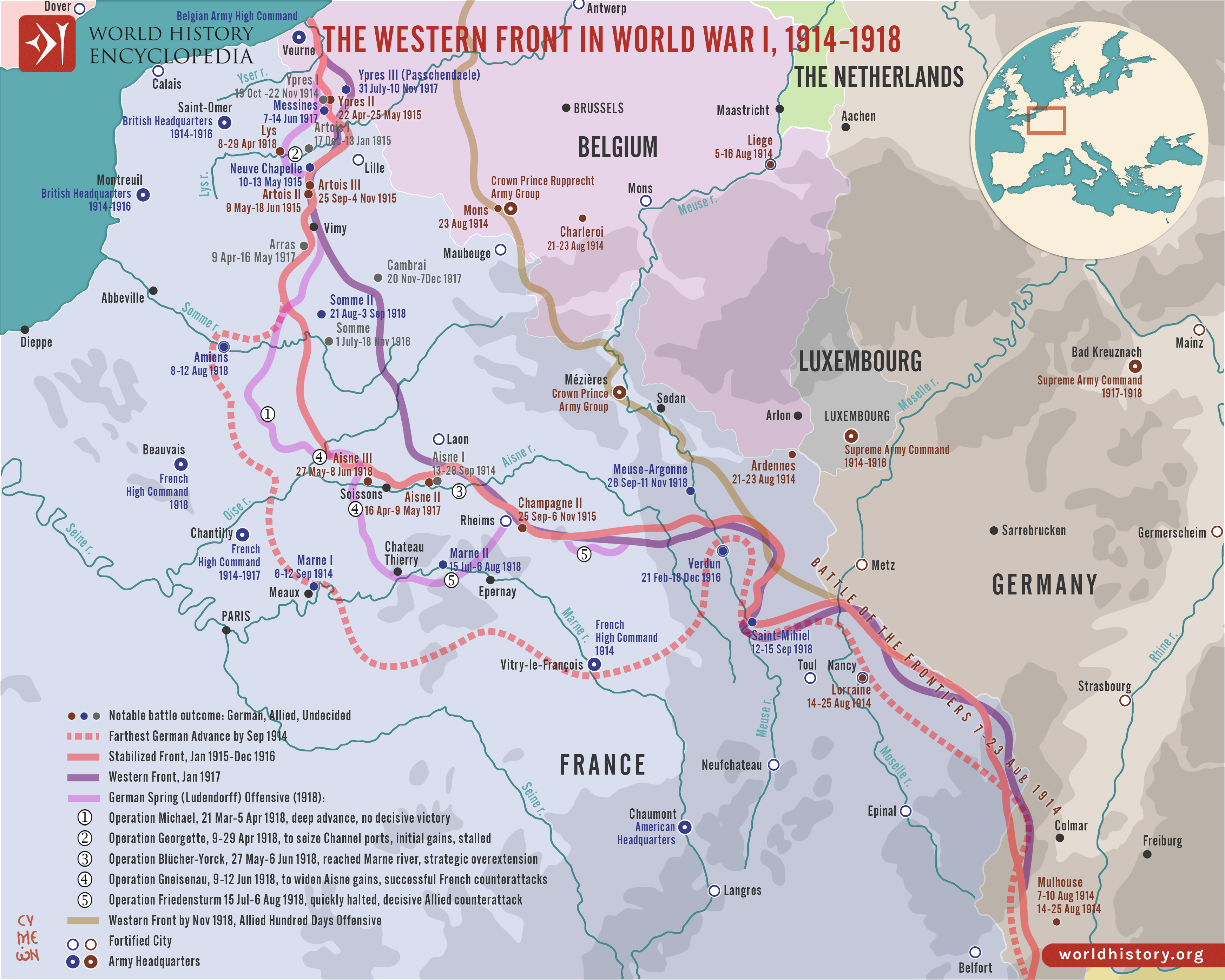
Map of the Western Front in World War I, 1914-1918

The Western Front (1914–1918) was the central and most industrialized theater of the First World War, emerging from Germany’s initial invasion of Belgium and northern France in August 1914 under Kaiser Wilhelm II (reign 1888–1918). Following the failure of the Schlieffen Plan and the stabilization of the front after the First Battle of the Marne (1914), the conflict evolved into a protracted war of attrition stretching from the North Sea to the Swiss frontier. Trench systems, fortified defensive belts, and unprecedented artillery concentrations reflected the dominance of industrial firepower over maneuver. Major engagements, Verdun (1916), the Somme (1916), Passchendaele (1917), revealed the strategic logic of exhaustion, as both the German Empire and the Allied powers sought to break the stalemate through material superiority and manpower mobilization.
By 1918, the balance shifted decisively. Germany’s Spring Offensive (March–July 1918), launched after the collapse of Imperial Russia, achieved temporary breakthroughs but failed to secure strategic victory. The subsequent Allied Hundred Days Offensive (August–November 1918), supported by American forces under President Woodrow Wilson (in office 1913–1921), shattered German defensive capacity. The 1918 Armistice with Germany ended hostilities on the Western Front, but the political consequences were profound: the abdication of Wilhelm II (1918), the collapse of empires, and the reconfiguration of Europe through the Treaty of Versailles (1919).