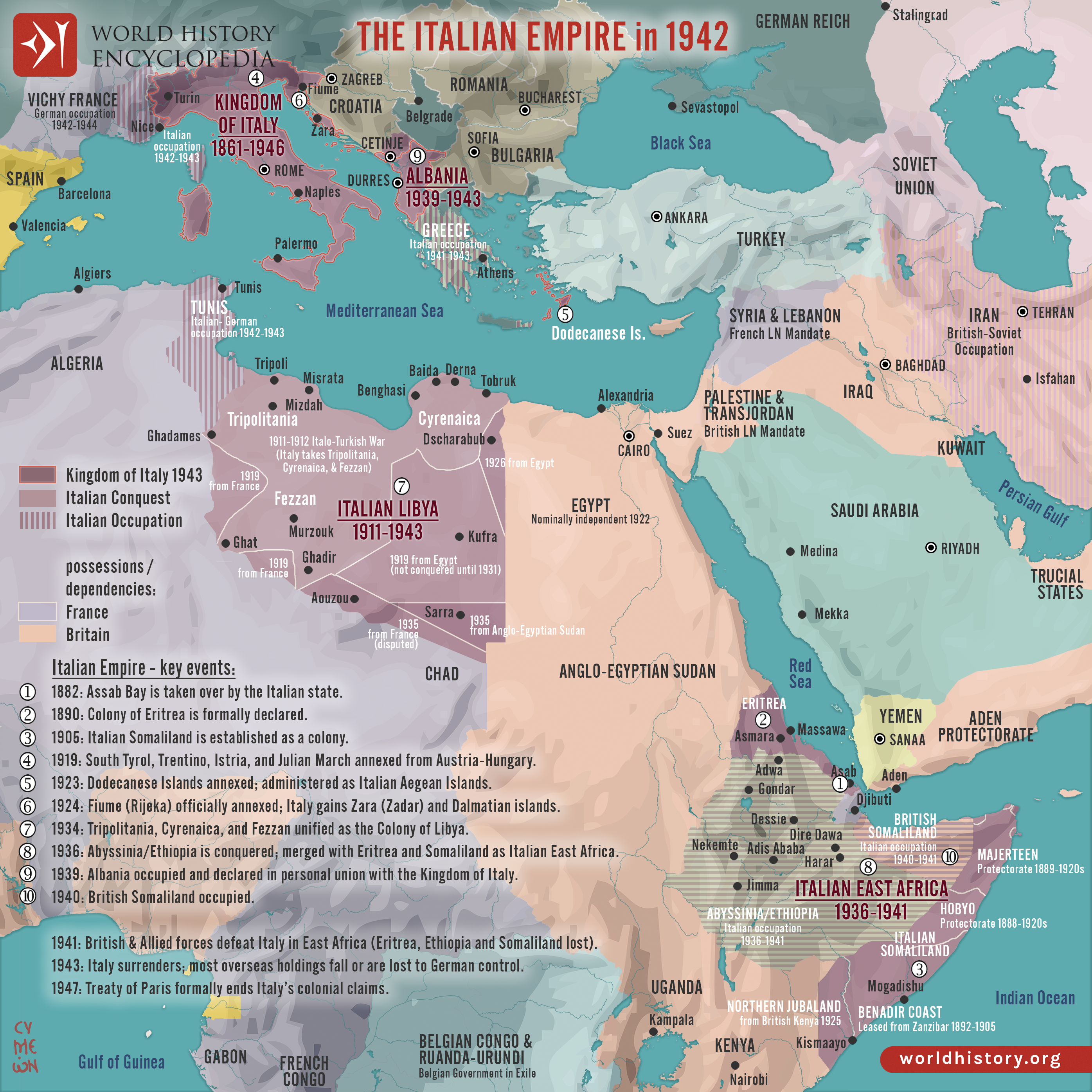
The history of Italian colonialism unfolded in a relatively short period, between the late 19th century and the Second World War (1939-45). After the unification of Italy, the young kingdom sought to establish itself as a European power, following the example of other colonial nations. This photo gallery attempts to retrace some of the stages in the history of Italian colonialism and its protagonists. Naturally, the images often convey ideological and political messages, the impact of which will be explained in the individual descriptions.
A Brief History of Italy's Colonial Ambitions
The opening of the Suez Canal in 1869 made the Red Sea a strategic area, and Italy took advantage of this with its first private initiative: in 1869, the missionary Giuseppe Sapeto, with the support of the Rubattino shipping company, purchased the Bay of Assab from the local sultan, which was used as a trading and supply port. In 1882, that same possession officially passed to the Italian state, marking the beginning of its colonial presence. Three years later, in 1885, Italy also occupied Massawa and began consolidating its control over the hinterland, establishing the colony of Eritrea.
From there, the attempt to expand towards Ethiopia began, but it ended with the resounding defeat at Adwa in 1896, when an African army succeeded in repelling a European colonial power for the first time. At the same time, Italy turned its attention to other parts of the Horn of Africa. Starting in the 1880s, thanks to agreements with local sultans, it obtained territorial concessions along the Somali coast, which were entrusted to private trading companies. These experiments, however, met with little success, and the Italian state was gradually forced to assume more direct control. Only in 1905, after the companies' administrations failed, did the Italian government officially assume management of the territory, which in 1912 effectively became a colony.
In the following years, under the Giolitti government, colonial expansion shifted to North Africa. In 1911, Italy declared war on the Ottoman Empire and conquered Libya, dividing it into the regions of Tripolitania and Cyrenaica, as well as occupying the Dodecanese.
With the rise of fascism, Italian imperialism took on a more aggressive dimension. Benito Mussolini aimed to build an "Italian Empire" and launched a harsh campaign of repression in Libya against the local populations, especially in Cyrenaica, where deportations and systematic violence were carried out. In 1935, Fascist Italy invaded Ethiopia, using chemical weapons, and in 1936 proclaimed the creation of Italian East Africa, uniting Eritrea, Somalia, and Ethiopia under a single administration. A few years later, in 1939, Albania was also annexed by Italy.
However, the colonial empire was short-lived. During WWII, between 1941 and 1943, the colonies were rapidly conquered by the Allies. With the post-war 1947 peace treaty, Italy formally lost all its colonial possessions. The sole exception was Somalia, which remained under Italian trusteeship on behalf of the United Nations from 1950 to 1960, until full independence was achieved.
Italian colonialism presented numerous challenges. Politically and militarily, it was marked by structural weaknesses: Italy had limited economic resources and armed forces compared to the major European powers, making it difficult to maintain stable rule. Socially, Italian colonialism was characterized by violence, repression, deportations, and the use of prohibited weapons, such as chemical gases in Ethiopia. Furthermore, the colonial administration failed to achieve lasting development in the conquered territories: infrastructure projects were limited and often served only Italian interests, without providing concrete benefits to the local populations. Finally, the memory of colonialism was long suppressed or justified in Italian public discourse, contributing to a problematic and still controversial relationship with that partciular chapter of history.