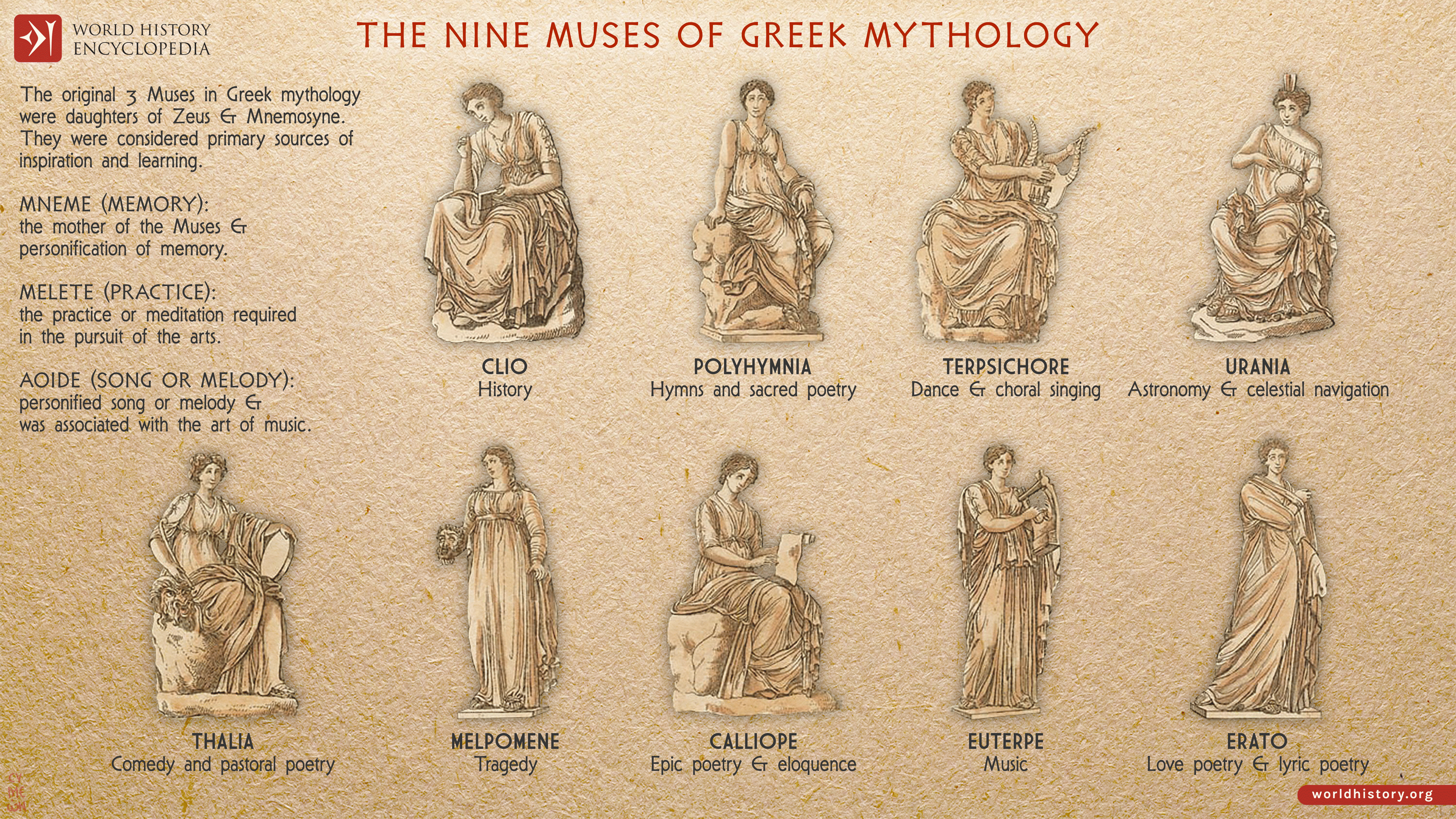
The Nine Muses of Greek Mythology

The Nine Muses of Greek mythology were divine daughters of Zeus and Mnemosyne (Memory), revered as patrons of poetry, song, history, and the arts. Early Greek tradition sometimes spoke of an earlier triad—Mneme (Memory), Melete (Practice), and Aoide (Song)—who embodied the essential elements of artistic creation. Over time, this conception expanded into the canonical nine, each inspiring a different sphere of creativity and knowledge. By the Archaic and Classical periods (c. 8th–5th centuries BCE), the Muses had become central to Greek religion, invoked by poets, musicians, and historians as sources of divine inspiration.
Hesiod (c. 750–650 BCE), in his Theogony, codified the Nine: Calliope (epic poetry, chief of the Muses), Clio (history), Euterpe (flute-playing), Thalia (comedy), Melpomene (tragedy), Terpsichore (dance and choral singing), Erato (love and lyric poetry), Polyhymnia (hymns and sacred song), and Urania (astronomy and celestial knowledge). Their influence endured far beyond antiquity, shaping Roman culture and later Renaissance and Enlightenment thought. As timeless symbols of learning and creativity, the Muses illustrate how mythology reinforced the value of memory, performance, and knowledge across centuries.