17th Anniversary Fundraiser
Celebrate our 17th anniversary with an anniversary gift to support free history education around the world!

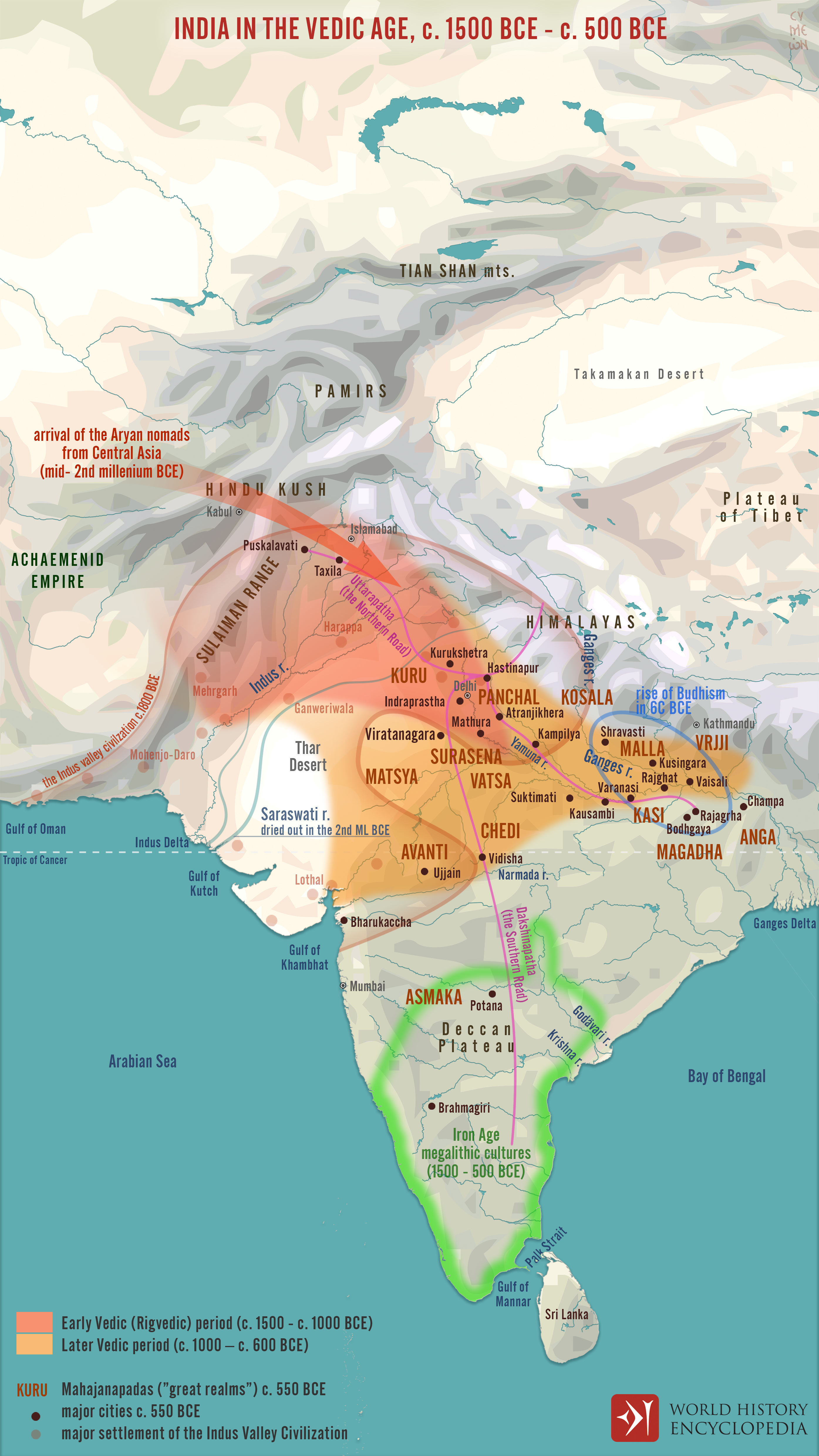
Map of India in the Vedic Age, 1500 BCE-500 BCE


The Vedic Age (c. 1500-500 BCE) marks a formative period in the history of the northern Indian subcontinent, bridging the decline of the Indus Valley Civilization (c. 1300 BCE) and the emergence of early states in the Gangetic plain. During this time, Indo-Aryan–speaking pastoral groups migrated and settled across northwestern and northern India, interacting with existing populations and gradually transforming the cultural landscape. The period is named after the Vedic corpus, a body of orally transmitted texts composed in early Sanskrit, which provide key insight into social organization, ritual practices, and early political structures. Rather than a unified state, the region was characterized by semi-nomadic clans and tribal polities, where authority rested with chieftains (rajas) and assemblies.
Over time, these societies underwent significant economic and political change, including the expansion of agriculture, the use of iron technology in the later phase, and the gradual movement eastward into the Indo-Gangetic plain. This process contributed to increasing social stratification, reflected in the development of the varna system, and to the emergence of more complex territorial polities. By c. 500 BCE, this transformation culminated in the rise of the Mahajanapadas (“Great Realms”), marking a transition toward urbanization, state formation, and new intellectual traditions.
Questions & Answers
When did the Indus Valley Civilization flourish?
- The Indus Valley Civilization flourished between c. 7000 and c. 600 BCE, although evidence of human activity in the region goes back much farther.
What are the two best-known cities of the Indus Valley Civilization?
- The two best-known cities of the Indus Valley Civilization are Harappa and Mohenjo-daro.
When was the Indus Valley Civilization discovered?
- The Indus Valley Civilization was discovered in 1829.
Has the script of the Indus Valley Civilization been deciphered?
- No. The Indus Script (also known as Harappan Script) has not been deciphered. All that is known of the culture comes from the ruins of the cities and artifacts found there.