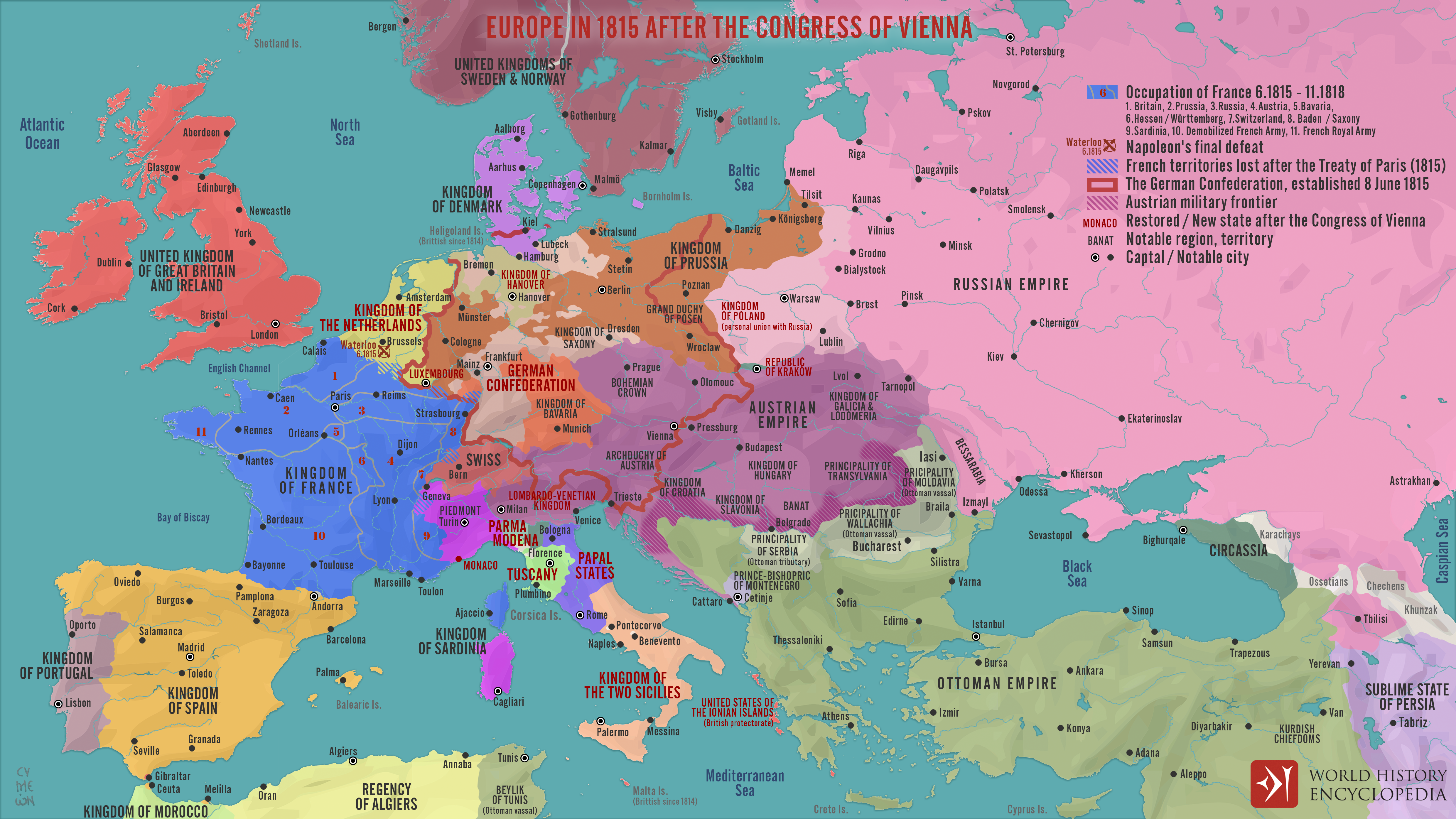
Map of Europe after the Congress of Vienna, 1815

The Congress of Vienna (September 1814–June 1815) marked a decisive attempt by Europe’s great powers to reconstruct political order after more than two decades of revolutionary and Napoleonic warfare (1792–1815). Led principally by Austria, Russia, Great Britain, and Prussia, later joined by a restored France, the settlement sought not simply to undo Napoleonic changes, but to establish a durable balance of power that would prevent the re-emergence of continental dominance by any single state. Rather than restoring borders wholesale to their pre-1789 form, diplomats combined dynastic legitimacy with pragmatic territorial adjustments, reshaping Central Europe through the creation of the German Confederation (1815), reorganizing Italian states, reallocating lands in Scandinavia and Eastern Europe, and reinforcing conservative monarchies as pillars of stability.
The settlement unfolded against the backdrop of Napoleon Bonaparte’s brief return during the Hundred Days (March–June 1815), following his abdication as Emperor of the French (reign 1804–1814; 1815). Although his final defeat at Waterloo (18 June 1815) occurred shortly after the signing of the Congress’s Final Act (9 June 1815), the Vienna system remained intact. Over the following decades, it institutionalized multilateral diplomacy through regular congresses, constrained revolutionary upheaval, and helped avert major great-power war until 1914. While often criticized for suppressing nationalist and liberal movements, the Congress of Vienna proved remarkably effective in shaping Europe’s political order and maintaining relative stability throughout much of the 19th century.