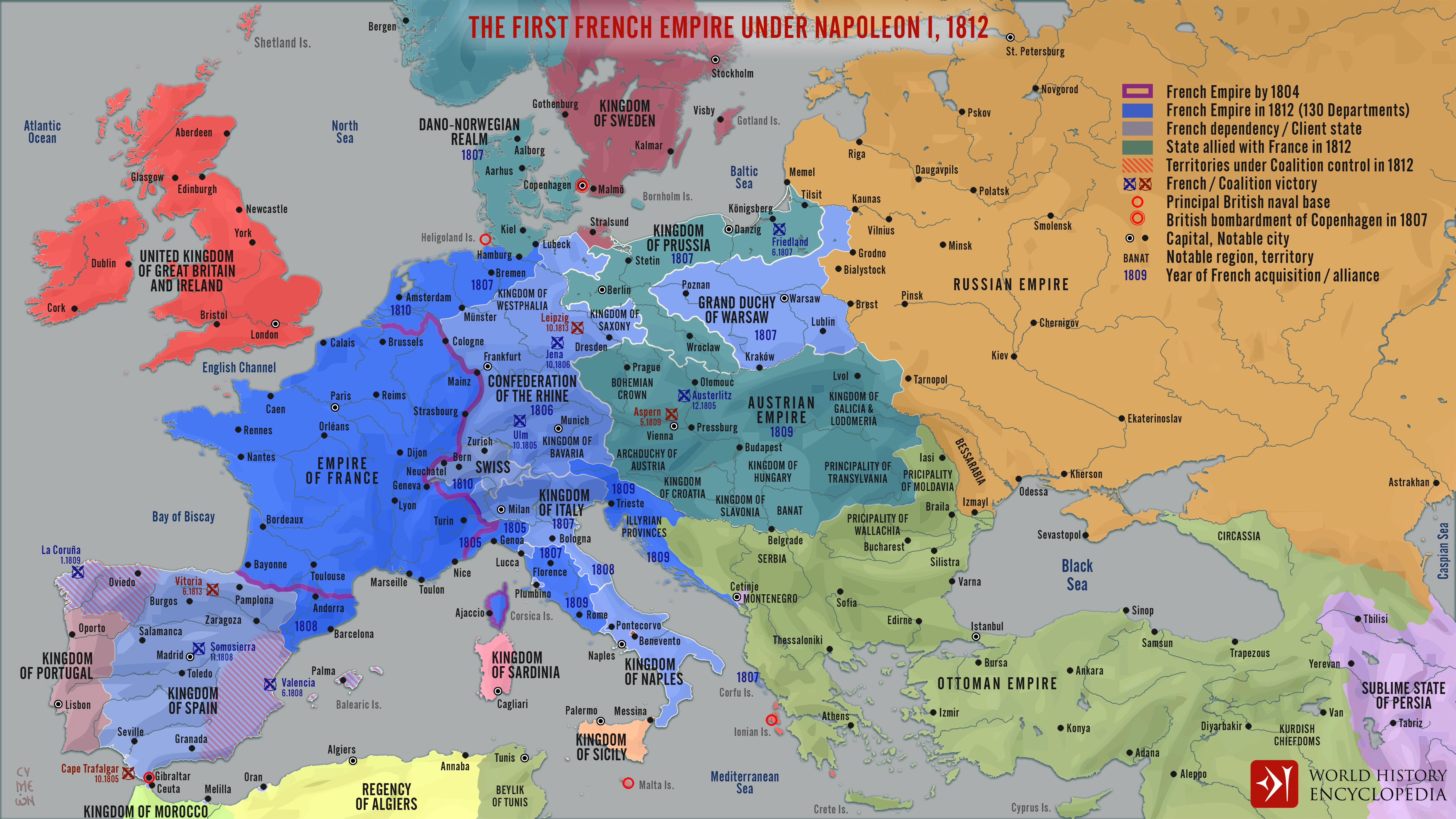
Map of the First French Empire and Napoleonic Europe, 1812

The First French Empire, established under Napoleon Bonaparte (Emperor 1804–1814; briefly 1815), represented the high point of French power in Europe following the French Revolution. Through sustained military campaigns and political restructuring, Napoleon extended French control or influence across much of continental Europe, from the Iberian Peninsula to Central and Eastern Europe, and from the North Sea to southern Italy. This expansion was driven by a combination of military innovation, mass conscription, and the reorganization of conquered territories into client states and satellite kingdoms, reshaping Europe’s balance of power in the early 19th century.
The Napoleonic Wars (1803–1815) transformed Europe politically and ideologically. While Napoleon’s rule dismantled or weakened many traditional monarchies, it also spread revolutionary principles such as legal equality, administrative centralization, and the Napoleonic Code, influencing governance far beyond France’s borders. At the same time, prolonged warfare provoked resistance, economic strain, and the rise of nationalist movements that ultimately undermined imperial control. Napoleon’s defeat and exile led to the Bourbon Restoration (1814–1830), but the political instability unleashed by his era endured. France would oscillate between monarchy and republic throughout the 19th century, producing a Second Republic (1848–1852), a Second Empire (1852–1870), and a Third Republic (from 1870), a legacy shaped in no small part by the Napoleonic experience.