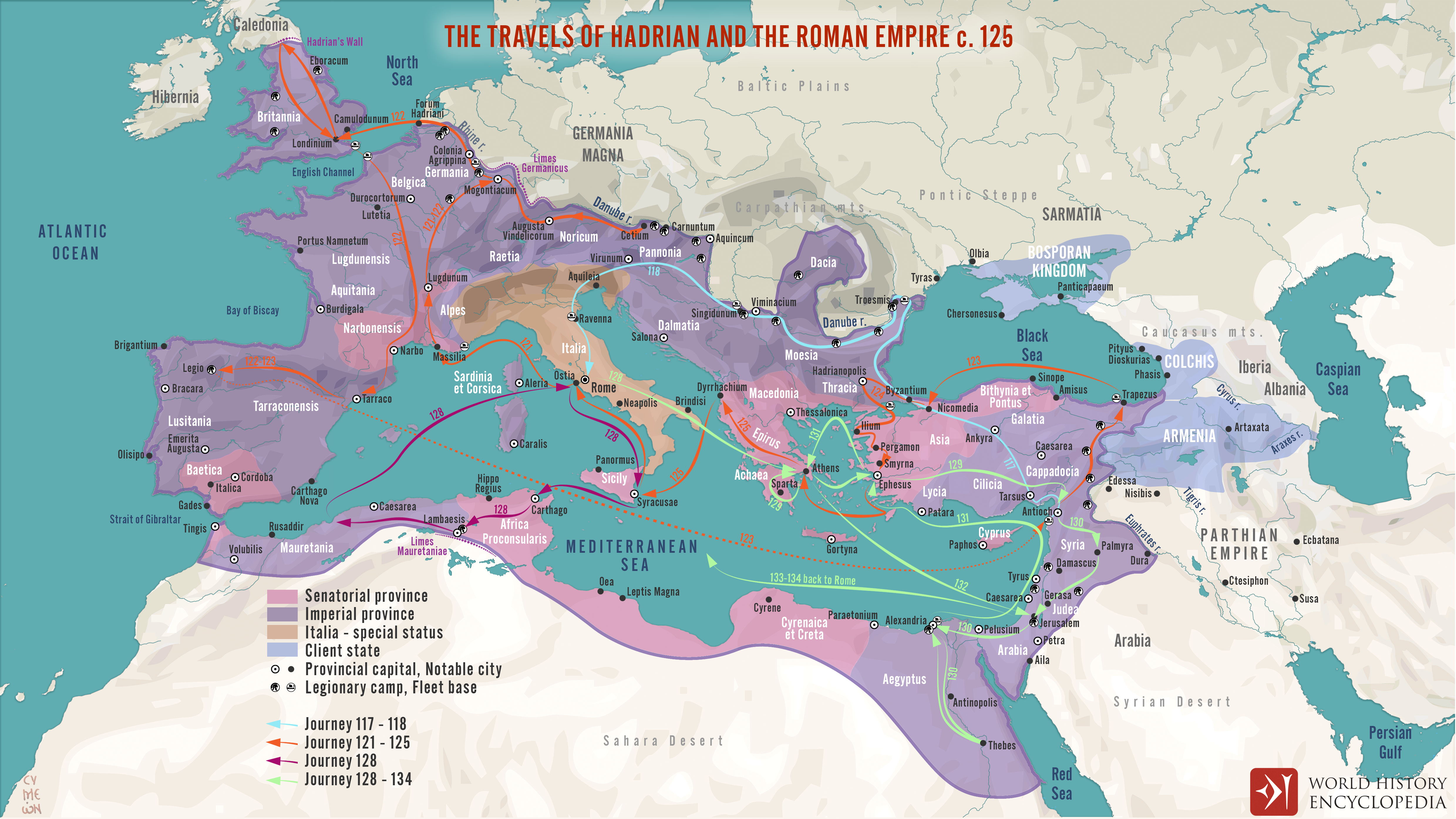
Map of the Travels of Hadrian & the Roman Empire c. 125 CE

This map illustrates the Roman Empire under Emperor Hadrian (r. 117–138 CE), who succeeded Trajan (r. 98–117 CE) at the height of Rome’s territorial expansion. Unlike his predecessor, Hadrian chose consolidation over conquest, shaping the empire into more stable and defensible frontiers while redefining the role of the emperor as a traveler and administrator rather than solely a military commander.
After securing his position, Hadrian embarked on extensive journeys that took him to nearly every province of the empire. He reorganized the army, strengthened defenses—most famously building Hadrian’s Wall in northern Britain—and promoted infrastructure, architecture, and cultural projects from Gaul to Judea. His reign marked a shift toward cosmopolitan unity: he fostered Greek learning and arts, redesigned cities like Athens, and initiated monumental constructions such as the Pantheon’s rebuilding in Rome. By spending over half of his 21-year rule outside Italy, Hadrian left a legacy of integration, stability, and cultural patronage that distinguished his era from Rome’s earlier expansionist centuries.