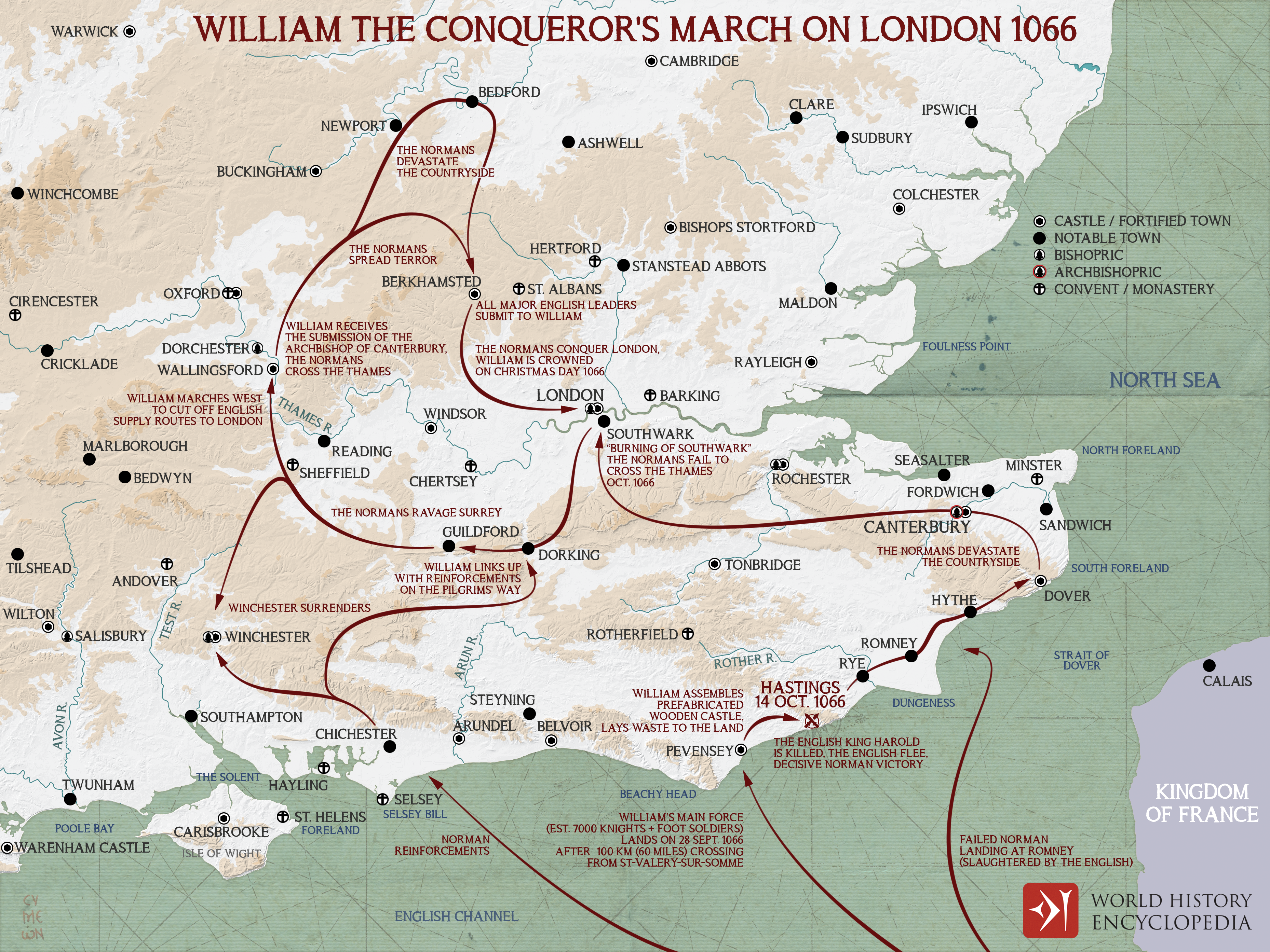
Map of William the Conqueror’s Campaign for London, 1066

William the Conqueror’s campaign for London formed the decisive second phase of the Norman invasion of England in 1066. After defeating Harold II (reign January–October 1066) at the Battle of Hastings on 14 October, William, Duke of Normandy, still had to secure recognition from England’s political and ecclesiastical elite. He advanced through Kent, obtained the submission of Dover and Canterbury, and tested London’s defences at Southwark before shifting westward, ravaging the surrounding countryside and crossing the Thames at Wallingford.
William’s campaign combined military pressure, control of communications, targeted destruction, and negotiated submission rather than relying on a direct assault against London. At Berkhamsted in early December, Edgar the Ætheling, leading earls, bishops, and representatives of London accepted his authority. William entered the capital and was crowned King of England (reign 1066–1087) at Westminster Abbey on 25 December 1066. The campaign transformed victory at Hastings into effective kingship and opened the way for the political, social, linguistic, and landholding changes associated with Norman rule.