
Search
Did you mean: Ramayana?
Remove Ads
Advertisement

 This answer was generated by
 Search Results

Article
A Short History of the Buddhist Schools
The different Buddhist schools of thought, still operating in the present day, developed after the death of the Buddha (l. c. 563 - c. 483 BCE) in an effort to perpetuate his teachings and honor his example...

Article
Tibetan Sand Mandalas
Tibetan sand mandalas are works of art created to encourage healing, peace, and purification generally as well as spiritual or psychological focus specifically for those creating and viewing it. A mandala (Sanskrit for "circle"...
Definition
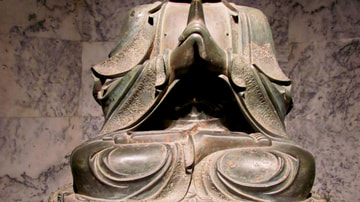
Esoteric Buddhism
Esoteric Buddhism is the mystical interpretation and practice of the belief system founded by the Buddha (known as Sakyamuni Buddha, l. c. 563 - c. 483 BCE). It is known by several names and is characterized by a personal relationship...

Definition
Buddhism
Buddhism is a non-theistic religion (no belief in a creator god), also considered a philosophy and a moral discipline, originating in the region of modern-day India in the 6th and 5th centuries BCE. It was founded by the sage Siddhartha...

Definition
Four Noble Truths
The Four Noble Truths are the foundational tenets of Buddhism, which spark awareness of suffering as the nature of existence, its cause, and how to live without it. The truths are understood as the realization which led to the...

Definition
Tara
Tara is a female deity in both Hinduism and Buddhism who personifies compassion and offers salvation from the suffering of rebirth and death. She is thought to have been born of empathy for the suffering world and is regularly invoked...
Image
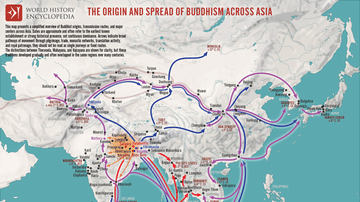
Map of the Spread of Buddhism Across Asia - The Making of a Pan-Asian Religion
Buddhism originated in the Ganges Plain of Magadha (modern Bihar, India) during the 5th–4th centuries BCE, following the enlightenment of Siddhartha Gautama, the Buddha (c. 5th...

Definition
Mahayana Buddhism
Mahayana Buddhism is the largest Buddhist sect in the world, and its beliefs and practices are what most non-adherents recognize as "Buddhism" in the modern era. It developed as a school of thought sometime after 383 BCE, possibly...

Definition
Indra - The Vedic Religion's Greatest God
The anthropomorphic god Indra was the most important god in the Vedic religion and he later became a major figure in Hinduism and an important deity in Buddhism, Cham and Chinese tradition. For the Aryas he...
Definition
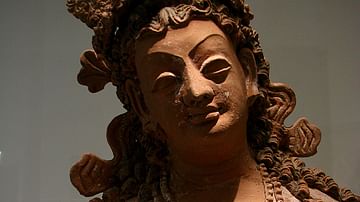
Mahasanghika
Mahasanghika (“Great Congregation”, also given as Mahasamghika) was an early Buddhist school of thought which is thought to have been formed after the Second Buddhist Council of 383 BCE when it separated itself from another school...
