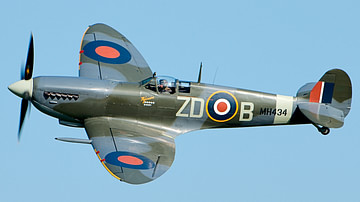


The North American P-51 Mustang was a long-range fighter aircraft used by the air forces of the United States and Great Britain during the Second World War (1939-45). Widely considered one of the most effective fighter planes of the war, the single-seater Mustang could operate as a reconnaissance aircraft, interceptor fighter, fighter-bomber, and long-range bomber escort. Used in most theatres of the war from 1944, the Mustang gained legendary status and continued to see action in the Korean War (1950-53).
Design Features
The Mustang was designed, developed, and put into production after WWII had already started. In April 1940, it was the British who first commissioned the North American Aviation Company to come up with a new fighter plane. With parts of Europe already occupied by Nazi Germany, the brief was to have a prototype ready in just four months. Designers Raymond Rice and Edgar Schmued studied the performance of fighter planes already being used in the war and came up with a prototype that impressed in testing. A little behind schedule because of engine delays, the first Mustang prototype, then called NA-73X, flew for the first time in October 1940. The aircraft's engine was made by Allison and could give an impressive 1,100 hp (820 kW). The aircraft also impressed pilots with its manoeuvrability, particularly at low altitudes. There was a problem, though: the Allison engine lost significant performance the higher it flew, especially over 12,000 ft (3,660 m). Nevertheless, the first aircraft were delivered to the British Royal Air Force (RAF) in November 1941.
The initial agreement to provide the British with Mustangs included the proviso that two planes would be made available to the United States Army Air Forces (USAAF). The two fighters, designated XP-51, received some design changes, notably a self-sealing fuel tank. Another 150 planes were made, and 93 of these were given to Britain under the Lend-Lease agreement; the remaining Mustangs were given to the USAAF. Ultimately, the Mustangs were built in their thousands and became one of the USAAF's main interceptor and escort fighters for the remainder of the war.
As with most aircraft during the war, the Mustang received regular updates and design improvements. The fuselage was strengthened, rivets were smoothed down to create a more aerodynamic fuselage, the ailerons were improved, the gun-loading mechanism was simplified to reduce jamming, and ever-more powerful engines were added. The laminar-flow wings, with their thicker parts set further back than on other fighter aircraft, gave the plane even more speed.

One persistent design problem had been the poor visibility for the pilot looking behind them. This issue was resolved by changing the cockpit canopy from a side-opening one to a sliding hood. Even better, the P-51D version had a bubble canopy, which gave the pilot a 360-degree view. New materials like plastic and a rethink of the basic internal structure greatly reduced the weight of later Mustangs (by about 40%), and this gave them a top speed of 487 mph (784 km/h).
Specifications
The typical Mustang had a wingspan of around 37 feet (11.2 m) and a length of 32 feet 3 inches (9.83 m). The typical maximum range was a little over 2,000 miles (3,350 km) with a maximum ceiling of 41,900 feet (12,770 m), although these figures depended on the specific models and certain modifications. As the aviation historian R. Neillands notes: "The P-51D, the most common version of the Mustang, had a range of 950 miles and could fly to Berlin and back" (225).
The initial armament of the first British-destined Mustangs consisted of eight machine guns, four 0.50 inch (12.7 mm) and four 0.30 inch (7.62 mm). This firepower made the aircraft ideal for ground attacks. The Lend-Lease Mustangs, however, were given four 20-mm cannons instead of the eight machine guns. Later Mustangs had either six 0.50-inch machine guns or were adapted to carry six or ten rockets. For bombing purposes, the Mustang could be fitted with two 1,000-lb (454-kg) bombs.

Use as a Reconnaissance Aircraft
The RAF flew Mustang Mark I planes from April 1942, first for tactical reconnaissance. The planes were each fitted with a camera situated behind the pilot. Through 1942, the RAF deployed 23 Mustang squadrons (over 600 aircraft), most of which operated over occupied Europe, in particular, acting as reconnaissance for the Allied bombing of Germany and identifying strategic targets like factories, transport hubs, and dams.
The RAF continued to use Mustangs, both from British bases and in the Mediterranean, such as Souk-el-Khemis in Tunisia. The USAAF deployed Mustangs from a wide range of bases, such as in Britain, mainland France, Corsica, and Hailakandi in India. Initially, the Mustang was also used by the USAAF as a reconnaissance aircraft, and so each plane was fitted with two cameras. These reconnaissance aircraft first saw action in the North Africa Campaign.
Changing Multi-Purpose Role
Impressed with the Mustang's general performance, the USAAF ordered another 500 aircraft, each fitted with dive brakes and racks under their wings to carry bombs. Flying from September 1942, these new dive bombers saw action in the Middle East and in the invasions of Sicily and mainland Italy. The Mustang's success in its new role convinced the RAF to test a further 50 or so aircraft.

There remained the weakness of the Allison engine at altitude, and so the RAF designers successfully tested the Mustangs with new Rolls-Royce engines. The use of Rolls-Royce's latest Merlin V-12 engine, which also provided power for the Supermarine Spitfire fighters, was the idea of test pilot Ron Harker. The USAAF, meanwhile, replaced their Allison engines with more powerful Packard-Merlin ones, a decision that required a new plant to be built in Dallas, Texas, to supplement that in Inglewood, California. Now, both the RAF and USAAF Mustangs could perform well up to 30,000 ft (9,144 m).
With new engines, the Mustang had been transformed into "a new and highly effective fighter – the finest piston-engined fighter of the war" (Neillands, 294). There was much debate during the war, and there has been ever since, as to whether the P-51 Mustang was better than the Supermarine Spitfire. Pilots who flew both aircraft generally regarded the Spitfire as being more manoeuvrable but recognised that the Mustang was faster, had a longer range, and, an important factor for pilots on long missions, a much more comfortable and roomier cockpit.
From the end of 1943, Mustangs were given extra disposable fuel tanks, typically each capable of carrying 55 gallons (208 litres) of additional fuel. Even more fuel could be carried within the wings and in an auxiliary tank located behind the cockpit. The extended range these tanks gave allowed the Mustang to escort Allied bombers deep into Germany, although they did reduce speed by around 14 mph or 22 km/h. These fighters could now fly further than any other Allied fighter and usually outperform anything the enemy could put up to stop them. The P-51 Mustang proved itself time and again superior to the USAF P-38 Lightning, which also served fighter-escort duty, and, more importantly, any German fighter in terms of speed, rate of climb, and operating height. Mustangs with ammunition left after a bombing raid were regularly tasked with causing havoc amongst the enemy on the flight home, using their heavy 0.50 bullets to attack opportunistic targets like canal boats, trains, trucks, and staff cars.

The arrival of the Mustang in large numbers through 1944 was vital for the Allied bombing effort since the US air marshals had insisted on daylight bombing raids despite the heavy losses these entailed. Daylight raids gave the bomb-sighters much better visibility but left the slow-flying bombers particularly vulnerable to enemy fighters. This was a harsh lesson the RAF had learned earlier in the war, but the USAAF, it seems, had to experience the deadly threat of German fighters like the Messerschmitt Bf 109 for itself. Now, with bombers escorted by Mustangs that could fly all the way to Berlin and back, the tide of the air war began to turn in the Allies' favour.
Similarly, Mustangs became particularly useful in the Pacific War against Japan, where aircraft were obliged to fly huge distances. When the US won the Battle of Iwo Jima in March 1945, Mustangs flew from that island to escort B-29 bombers in their raids on Japan itself. The Mustangs not only protected the bombers from enemy fighters but their very presence also allowed the bombers to fly in much looser and, therefore, safer formations. The Mustangs helped reduce B-29 losses to well below the 5% figure commanders considered acceptable. Mustang dive bombers were also deployed to themselves attack ground targets in Japan.
Mustangs operated in just about every major theatre of the war in 1944 and 1945. In all, some 14,800 Mustangs were built during the conflict. According to the National Museum of the United States Air Force, "by the end of the war, Mustangs had destroyed 4,950 enemy aircraft in the air, more than any other USAAF fighter in Europe."
Later Service
After the conflict, limited production continued in Australia, of all places, where a licensed factory had been set up in 1944. Mustangs had also been supplied to many other air services, notably in China, Australia, South Africa, and the Netherlands. US Mustangs continued to see service after WWII, notably in the US Air Reserves and the Air National Guard, where they were redesignated F-51s. Although now overtaken by newer aircraft, a number of Mustangs saw active service during the Korean War, where their long-range capabilities still made them very useful. The last operational Mustangs were flown in the early 1980s by the Fuerza Aérea Dominicana of the Dominican Republic.