
Search
Remove Ads
Advertisement

 This answer was generated by
 Search Results

Image
Mesoamerican Ballgame Players
A ceramic vessel with painted scenes of Maya players of the Mesoamerican ballgame. Guatemala, 700-800 CE. (St. Louis Art Museum, Missouri)

Article
Turquoise in Mesoamerica
Turquoise was a highly-prized material in ancient Mesoamerica, perhaps the most valued of all materials for sacred and decorative art objects such as masks, jewellery, and the costumes of rulers and high priests. Turquoise...

Collection
Mesoamerican Civilizations
Ancient Mesoamerica (modern-day Mexico and Central America) witnessed an extraordinary flourishing of cultures from the beginnings of the Olmec civilization around 1200 BCE, through the Maya civilization and on to the...

Article
Aztec Pantheon
The gods of the Aztecs (1345-1521 CE) were many and varied and, as with many other ancient cultures, deities were closely associated with things and events important to the culture and the general welfare of the community. These...

Article
Obsidian in Mesoamerica
Obsidian is a dark volcanic glass which provides the sharpest cutting edge available in nature. Ancient Mesoamerican cultures greatly esteemed the properties of obsidian, and it was widely traded across the region. Obsidian...
Image
Map of the Mesoamerican Civilizations
The Mesoamerican civilizations represent a long continuum of complex societies that emerged independently in Central America and southern Mexico from roughly 1500 BCE to the early 16th century CE, prior to Spanish...

Image
Map of The Olmec World and Its Mesoamerican Connections - Power, Resources, and Interaction Networks, c. 1500–400 BCE
The Olmec world developed in the tropical lowlands of present-day Veracruz and Tabasco during Mesoamerica’s Formative period (c. 1500–400 BCE). Major...
Image
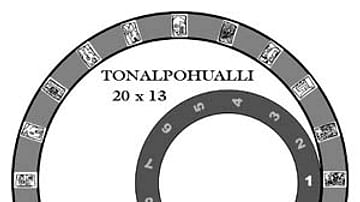
Tonalpohualli Mesoamerican Calendar
A representation of the Tonalpohualli – ‘Counting of the Days’ 260-day calendar used by ancient Mesoamerican cultures. Two systems ran simultaneously with a group of 13 numbered days combined with a group of 20...

Image
Mesoamerican God 2 Rabbit
A sculpture of the Mesoamerican god known to the Aztecs as 2 Rabbit who often represented the pulque gods. These gods represented the alcoholic drink pulque and were also known as the Centzon Totochtin (400 Rabbits). 1100-1300...

Image
Mesoamerican Canine Vessel
Ceramic Mesoamerican canine vessel from South-Central Veracruz, Mexico, c. 600 to c. 900. This open ceramic bowl from the Veracruz Late Classic period features a mould-made effigy of a canine resembling a xoloitzcuintle...
